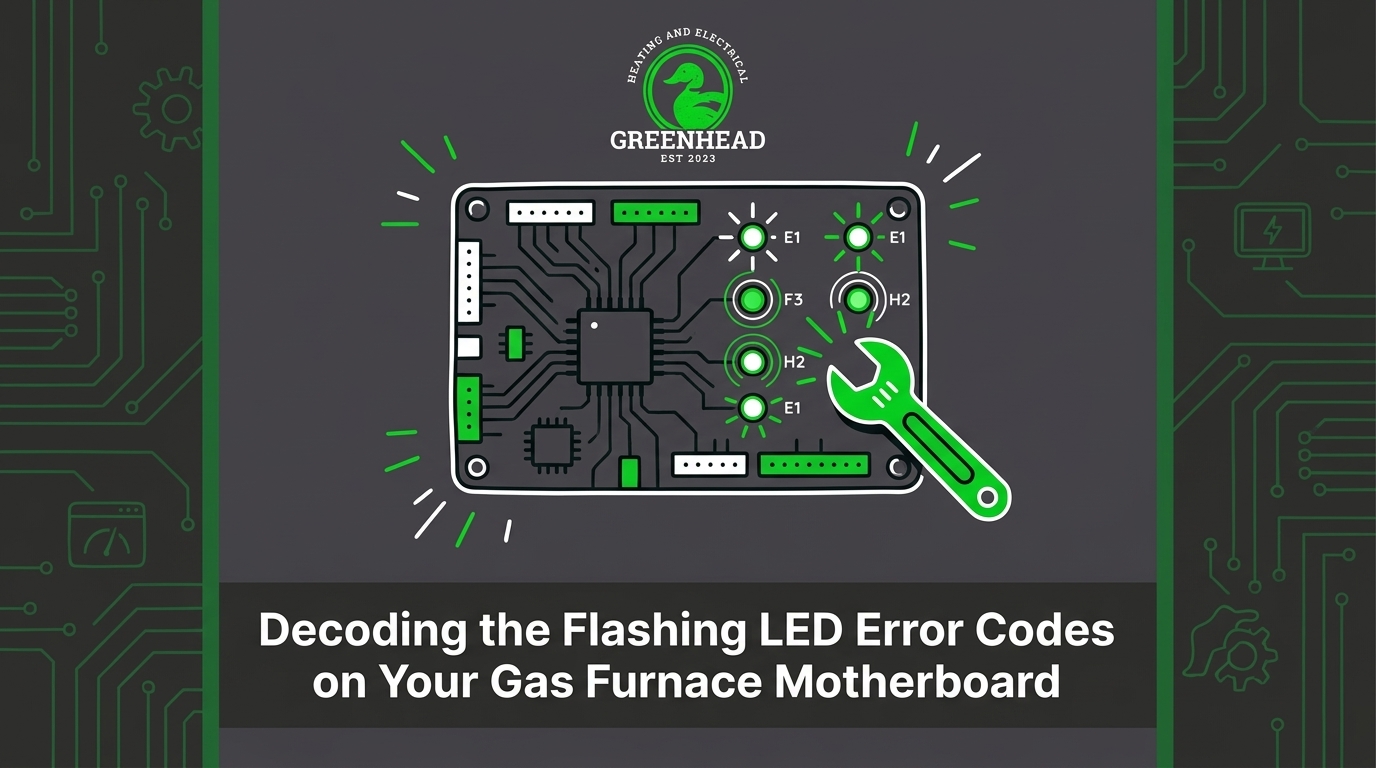
Decoding the Flashing LED Error Codes on Your Gas Furnace Motherboard
A Flashing Light During Your First Fall Startup: What It Means
You turn the thermostat to "heat" for the first time this autumn, expecting warm air to fill your home, but instead, you are greeted by silence—and when you check the basement, you find yourself decoding the flashing LED error codes on your gas furnace motherboard. Before you panic, understanding HVAC system diagnostics can help you communicate the issue clearly when you call our team for professional heating repair.
In our years of serving Puyallup, we've found that turning on your heat during an October pre-winter heating startup often reveals dormant issues. For months, your furnace has sat idle. During this time, dust settles on sensitive sensors, spiders build webs inside burner tubes, and condensation lines can dry out or become clogged. When the thermostat finally calls for heat, the system runs through a strict sequence of safety checks before it will ignite the gas. If any single component fails its check, the furnace halts the startup process to keep your home safe.
This is where the flashing LED light comes in. That blinking light visible on the lower panel of your furnace is not a reason to panic; it is a built-in diagnostic tool designed to tell you exactly which safety check failed. The motherboard acts as the brain of your heating system, constantly monitoring airflow, gas pressure, exhaust venting, and flame quality. When it detects an anomaly, it translates that problem into specific LED flash sequences.
Understanding the general meaning of this code helps you determine your next steps. It allows you to figure out if you simply need to check your air filter, or if you need to call our technicians to handle a complex electrical or gas-related failure. Our professionals actually rely on these exact same codes as their starting point for troubleshooting, making that little blinking light one of the most important communication tools in your entire home.
The Golden Rule: Do Not Open the Blower Door
The problem: The most common mistake we see homeowners make when they spot a flashing light is immediately removing the front metal panel of the furnace cabinet to get a closer look at the motherboard.
The cause: Modern gas furnaces are equipped with a critical safety mechanism called a blower door switch. This is a small, spring-loaded button located along the edge of the cabinet frame. The moment you pull that lower door off, the switch pops outward and instantly cuts all 120V electrical power to the entire system. This is designed to protect you from coming into contact with high-voltage components or the spinning blower wheel. However, standard furnace control boards use volatile memory. Just like a desktop computer losing an unsaved document when the power goes out, cutting the power to the furnace immediately clears the volatile memory on the motherboard. The very code you were trying to read is instantly erased.
The solution: You must always observe the blinking light exclusively through the transparent sight glass on the lower door. By leaving the door firmly in place, the power remains on, the motherboard retains the fault code in its active memory, and you can safely record the LED flash sequences without accidentally wiping the diagnostic slate clean.
• Volatile Memory (Most Common) — How It Reacts to Power Loss: Wipes completely when power is cut. — Impact on Error Codes: Codes are lost the moment the blower door is opened.
• Non-Volatile Memory (High-End Models) — How It Reacts to Power Loss: Retains data without active power. — Impact on Error Codes: Stores a history of past fault codes for technicians to retrieve later.
How to Safely Read the Sight Glass Sequence
Reading the code correctly requires patience and a clear line of sight. By following a specific process, you can accurately document the LED flash sequences without putting yourself at risk or resetting the system.
1. Locate the sight glass: Look for a dime-sized or quarter-sized transparent plastic window on the bottom half of the furnace cabinet (the blower compartment door). You may need to turn off the lights in the room to see the LED glowing clearly through the plastic.
2. Watch the rhythm for a full minute: Do not start counting the second you see a flash. The motherboard repeats the code on a continuous loop. Watch it for 60 seconds to identify where the sequence begins and ends.
3. Count the short, rapid flashes first: Most modern furnace codes are a two-part sequence. The first set of flashes will be quick and rapid. Count these carefully and write the number down. (For example, three short flashes).
4. Count the long, sustained flashes second: After a brief pause, the LED will blink again, but these flashes will stay illuminated slightly longer. Count these and write them down next to your first number. (For example, two long flashes).
5. Note the pause: There will be a distinct, longer pause (usually 2 to 3 seconds) before the entire sequence repeats. This pause confirms you have captured the complete code. In our example, you would have a "Code 32".

Translating the Flashes: Common System Faults
Once you have recorded the flash sequence, you can consult the diagnostic chart located on the inside of the furnace door (which you can check only if the furnace is completely off and you don't mind losing the active code) or in your owner's manual. It is vital to understand that these translations indicate general categories of failure, not necessarily the specific part that has broken. During a recent crisp Puyallup autumn, one of our local customers lost heat entirely; because they noted the specific error code pointing to a faulty switch, our technicians arrived that same afternoon with the right diagnostic approach, replacing the part and restoring heat by evening.
Airflow and Limit Switch Codes
One of the most frequent errors our team sees during an October pre-winter heating startup relates to airflow restrictions. The furnace contains a high-limit switch that monitors the temperature of the heat exchanger. If the system cannot push enough air over the heat exchanger, the metal gets dangerously hot, and the limit switch trips to shut off the gas burners.
• The usual suspect: A severely clogged air filter that is suffocating the blower motor.
• Closed vents: Too many blocked or closed supply registers in the house preventing proper circulation.
• The takeaway: This is the only scenario where a homeowner can safely attempt a fix by checking and replacing a dirty air filter before calling our professionals.
Ignition and Sensor Codes
Another incredibly common fault category we encounter involves the ignition sequence. When the furnace attempts to light, it opens the gas valve and uses a flame sensor to verify that a fire has actually started. If the sensor does not detect a flame within a few seconds, it immediately shuts the gas valve to prevent raw gas from flooding your home.
• The usual suspect: A dirty flame sensor coated in microscopic dust or carbon buildup from months of inactivity.
• Gas supply issues: A closed gas valve or a faulty igniter that fails to glow hot enough.
• The takeaway: Ignition failures require a professional to safely clean the sensor assembly with specialized materials (never regular sandpaper, which leaves damaging grit behind) or test the gas pressure.
Pressure Switch Codes
High-efficiency condensing furnaces use a pressure switch to ensure the exhaust gases are venting safely out of the house before the burners are allowed to ignite. We frequently find that if a bird builds a nest in your PVC exhaust pipe over the summer, or if the internal condensation drain lines become blocked with sludge, the pressure switch will detect the backup and lock the system out, triggering a specific LED flash sequence.
Why Motherboard Diagnostics Require Electrical Expertise
It is easy to assume that knowing the error code is the same as knowing how to fix the furnace. However, an error code only points to a general system or safety circuit; a professional-grade multimeter is required to test the actual motherboard components and pinpoint the exact point of failure. This is where mechanical heating knowledge must intersect with advanced electrical troubleshooting.
Furnace motherboards are complex electrical hubs. They use low-voltage 24V AC power to communicate with your thermostat and manage logic controls, but they actively manage and route high-voltage 120V AC power to heavy-duty components like the blower motor and the hot surface igniter. Testing for voltage drops, verifying continuity across safety switches, or hunting down electrical shorts inside a cramped metal cabinet poses severe shock hazards to anyone without proper training.
The dual-license advantage: Because a furnace involves both complex mechanical heating cycles and sensitive circuitry, our dual-licensed (HVAC and Electrical) expertise at Greenhead Heating & Electrical means our technicians are uniquely qualified to safely test both 120V and 24V components on the board. Proper diagnosis requires specialized knowledge of exactly how electricity flows through the sequence of operations. Our technicians don't just guess which part is broken; they use the LED flash sequences as a map, and their multimeter as the compass, to prove exactly where the electrical circuit is failing.
Using the Code to Communicate with Your Technician
The true value of reading your furnace's error code isn't in fixing it yourself—it is in drastically speeding up the professional repair process. When you call us for furnace repair in Puyallup, sharing that exact sequence with our dispatchers changes the entire trajectory of your service visit. With Puyallup's average October low temperatures dropping into the 40s, rapid, accurate diagnostics are essential before a true winter freeze sets in.
Writing down the exact flash sequence helps our team prioritize your call appropriately. If you report an ignition lockout code, our technicians can arrive with the correct diagnostic tools and the most likely OEM replacement parts already pulled from our warehouse, such as a specific flame sensor or hot surface igniter. When one of our Puyallup customers called for service on an older furnace, providing symptoms upfront helped our technician arrive fully prepared; our punctual, professional service had the system running smoothly in no time.
Accurate initial communication reduces the total time your home spends without heat. It prevents the dreaded scenario where a technician diagnoses the issue, only to realize they need to drive across town to a supply house to get a specific pressure switch. This is also why you should never reset the furnace by flipping the breaker just to "clear" the code before our technician arrives. Leave the system exactly as it is, blinking light and all, so our experts can see exactly what the motherboard is reporting.
When a Blinking Light Becomes an Urgent Call
The problem: Not all error codes carry the same weight. While a soft lockout might just mean the furnace needs a moment to reset after a minor airflow hiccup, certain LED flash sequences indicate a critical failure that requires immediate escalation.
The cause: A continuous, rapid flashing light with no pauses often indicates a hard lockout, a total polarity reversal in the electrical supply, or a catastrophic failure of the motherboard itself. If the furnace is completely unresponsive despite a clear call for heat from the thermostat, the system has shut itself down to protect your home from a severe safety hazard. Another local homeowner recently called us with no heat during freezing weather; because they communicated the urgency of a completely unresponsive system, our team arrived the same day, quickly identified the issue causing the hard lockout, and restored warmth.
The solution: Knowing when a furnace issue becomes an after-hours emergency is vital for your family's safety. If you observe a rapid, continuous flash, or if the blinking light is accompanied by the smell of raw gas (rotten eggs) or electrical burning (ozone or melting plastic), immediate action is required. Shut off the power to the furnace at the breaker, turn off the gas supply valve next to the unit, and make an urgent call to our team for professional help. Waiting too long on a locked-out furnace during an October pre-winter heating startup can quickly lead to uncomfortably cold indoor temperatures.
Frequently Asked Questions About Furnace Error Codes
What does a blinking red light on my furnace mean?
A blinking red light means the furnace's control board has detected a fault in the system's sequence of operations. It acts as a diagnostic tool, flashing in specific patterns to indicate which safety switch or component caused the system to shut down. It is not necessarily a sign of a ruined furnace, but rather a protective measure to keep your home safe.
How do I read my furnace error codes without opening the door?
You can safely read the codes by looking through the clear plastic sight glass located on the lower blower compartment door. Watch the LED flash sequences for a full minute to establish the pattern, counting the short flashes first, followed by the long flashes. Never remove the metal door to get a closer look, as this will trigger a safety switch and erase the code.
Why is my furnace light flashing 3 times?
A three-flash code commonly points to a pressure switch error or a draft safeguard issue, depending on your specific furnace brand. In our experience, this usually means the system is detecting a blockage in the exhaust venting, a clogged condensation drain, or a failure in the inducer draft motor. Because this involves safely venting combustion gases, it requires a professional diagnosis.
Does a flashing light on a furnace mean it is broken completely?
Not necessarily. Many codes indicate minor safety lockouts triggered by simple issues, such as a severely clogged air filter restricting airflow. While the furnace will not run while the code is active, replacing the filter or having our technicians clean a dirty flame sensor is often all that is needed to clear the code and restore normal operation.
Should I reset my furnace if the light is blinking?
You should avoid resetting the system until you have carefully recorded the exact flash sequence. Flipping the breaker or turning off the furnace switch will erase the volatile memory on the motherboard, deleting the code. Once you have written the code down, you can try resetting the power once to see if it was a temporary glitch, but if the code returns, leave it alone and call a technician.
What is the difference between a soft lockout and a hard lockout code?
A soft lockout is a temporary pause where the furnace shuts down after a failed ignition attempt but will automatically try again after a set period (usually one hour). A hard lockout occurs when the system detects a severe or repeated safety failure, shutting down completely and requiring a manual reset or a professional repair before it will attempt to operate again.
Handing the Diagnosis Over to a Licensed Expert
Reading the sight glass is your first line of defense when your heating system acts up. It empowers you to understand the general health of your system and provides crucial information to our HVAC dispatchers. However, translating the LED flash sequences is only the beginning of the diagnostic process. Repairing the underlying issue safely requires professional training, specialized tools, and a deep understanding of both high-voltage electricity and combustible gas.
Avoid the severe safety risks of DIY electrical testing on your furnace motherboard. When that little light starts blinking, document the pattern, leave the blower door securely shut, and share your flash sequence with a licensed expert. By trusting our dual-licensed professionals at Greenhead Heating & Electrical with your professional heating repair, you ensure that your system is thoroughly tested, correctly repaired, and safely brought back online to keep your home warm all winter long.
.svg)