Evaluating Existing Ductwork Before Adding a Heat Pump to Your Puyallup Home
The Hidden Danger of Upgrading Your Heating System Without Duct Evaluation
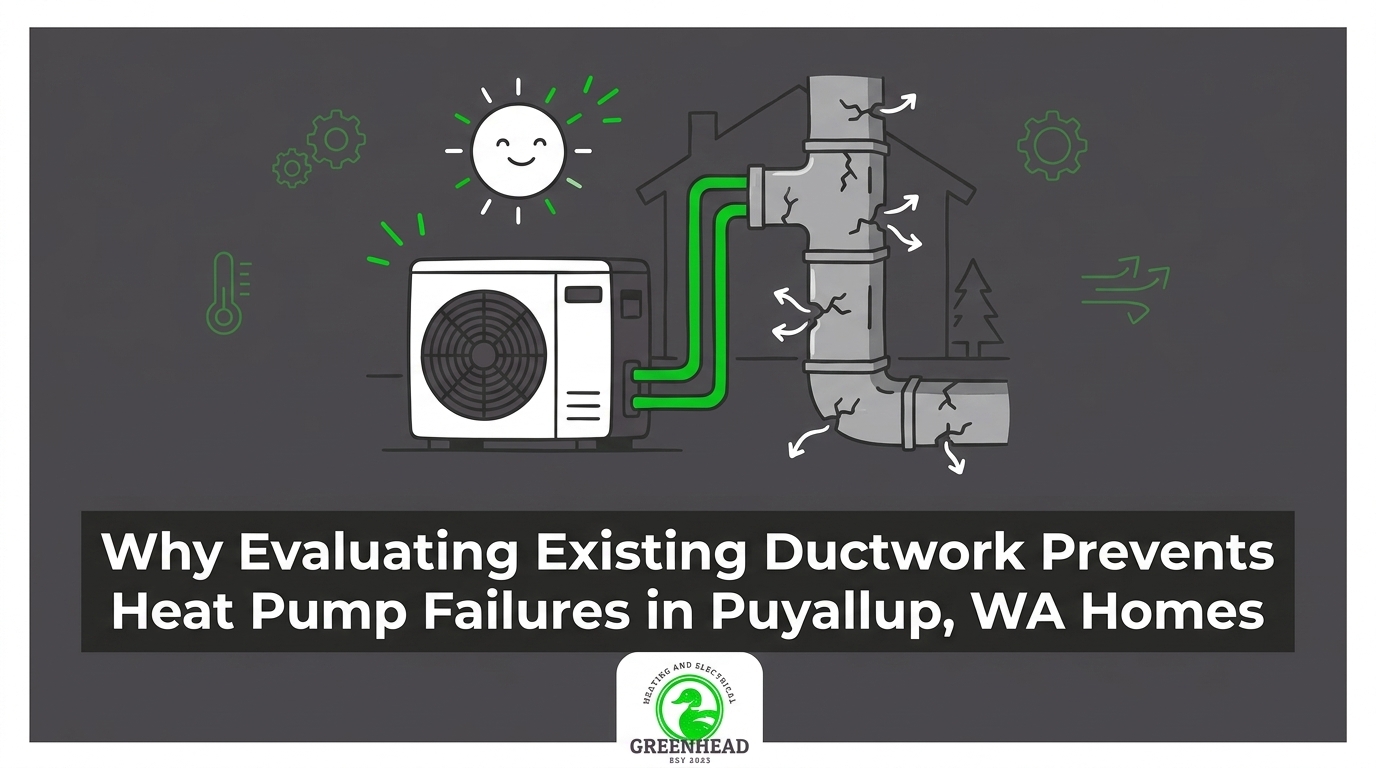
Your current furnace is struggling, and you are ready to make the upgrade to a modern, energy-efficient system. But before you finalize that decision, there is a critical diagnostic step you cannot skip. Evaluating existing ductwork before adding a heat pump to your Puyallup home is the only way to prevent your brand-new equipment from underperforming on day one. Installing a high-efficiency unit onto a failing or restrictive older duct system guarantees poor performance, frequent breakdowns, and wasted energy.
As our team at Greenhead Heating & Electrical gears up for the busy September pre-heating season transition, we see many homeowners rush to replace their aging equipment before the cold weather sets in permanently. In this rush, the physical condition of the home's air distribution system is often ignored. The focus stays entirely on the shiny new box sitting outside, while the hidden network of metal and flex pipe in the attic or crawlspace remains untouched.
This creates a massive blind spot. The transition to a new heating system requires a strict go/no-go testing phase where the existing infrastructure is thoroughly evaluated. Testing the static pressure and overall integrity of your ducts is a mandatory quality control step, not an optional upsell. Without it, you risk suffocating your new investment.
To learn more about your upgrade options and professional testing, explore our heat pump systems and duct design and evaluation services.
The Airflow Difference: Gas Furnaces vs. Modern Heat Pumps
To understand why your current ducts might struggle with a new system, you have to look at how different heating technologies move air. High-efficiency heat pumps operate on a fundamentally different airflow model than the traditional gas furnaces that have heated Pacific Northwest homes for decades.
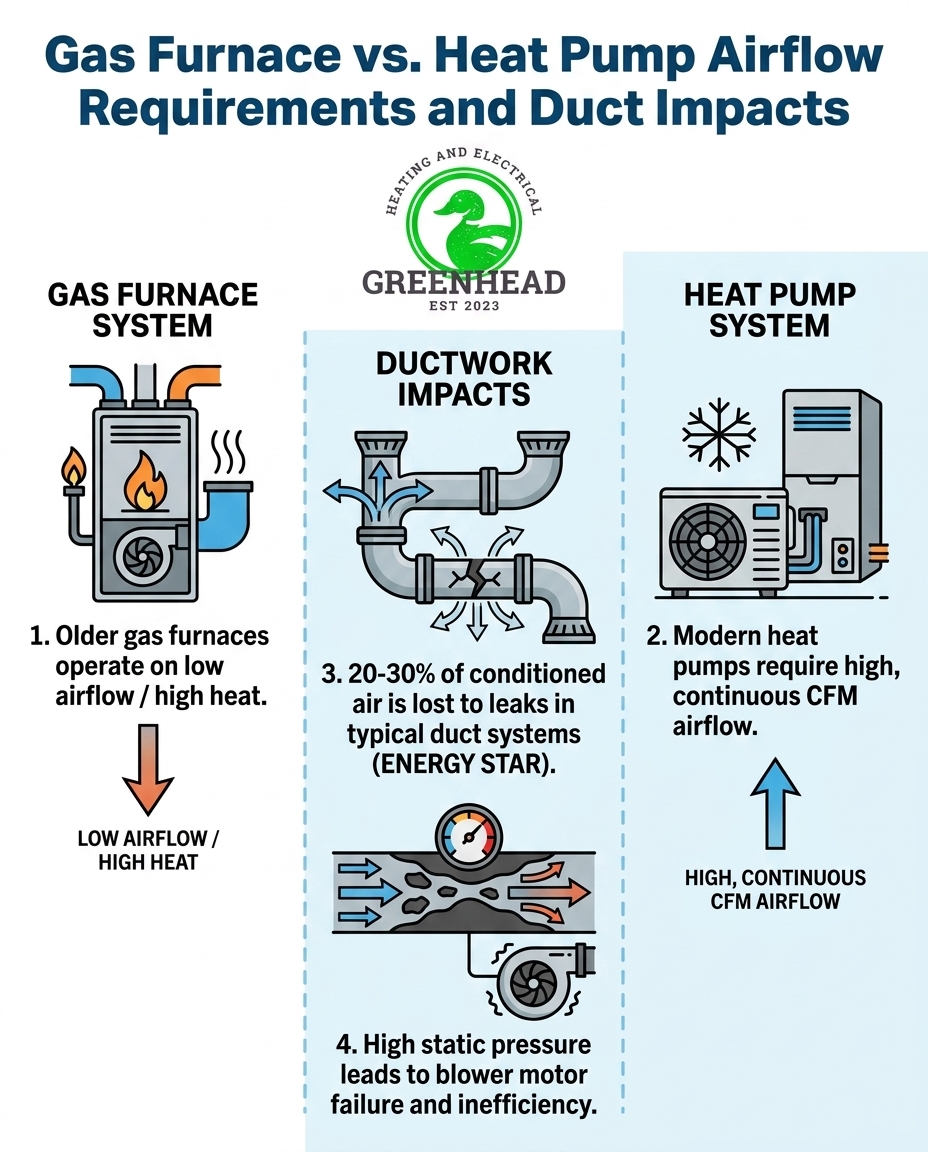
Older gas furnaces were designed for high-heat, low-airflow operation. They blast very hot air (often between 120°F and 140°F) in short, intense cycles. Because the air is so hot, the furnace does not need to move as much volume to warm up a room. In our years servicing local neighborhoods, our technicians consistently find that much of Puyallup's older residential infrastructure was built with ductwork sized specifically for these low-airflow gas systems. The pipes are often smaller, and the return air grilles are frequently undersized.
Modern heat pumps take the opposite approach. They produce a milder heat (typically around 90°F to 100°F) but run for longer, sustained periods. To deliver the same amount of total warmth to your living space, a heat pump must move a significantly higher volume of air continuously. If you connect a high-volume heat pump to small, restrictive ducts designed for a gas furnace, the system becomes immediately bottlenecked. This restriction forces the blower motor to overwork, leading to short cycling, overheating, and a massive drop in efficiency.
Before proceeding with any major installation, consulting with professionals who provide comprehensive Puyallup HVAC services ensures your home's infrastructure can actually support the technology you are buying.
• Older Gas Furnace — Air Temperature Delivered: 120°F - 140°F — Airflow Volume Required: Low to Moderate — Cycle Length: Short, intense bursts
• Modern Heat Pump — Air Temperature Delivered: 90°F - 100°F — Airflow Volume Required: High and Continuous — Cycle Length: Long, steady cycles
Why CFM Matters for Heat Pump Efficiency
In the HVAC industry, airflow is measured in CFM, which stands for Cubic Feet per Minute. This metric determines exactly how much conditioned air is moving through your vents at any given time. Because heat pumps transfer heat from the outside air rather than generating it through combustion, they rely heavily on achieving their exact target CFM to distribute comfort evenly throughout the house.
Signs of mismatched CFM ratings include:
• Severe hot and cold spots: Rooms furthest from the indoor unit receive little to no airflow.
• Constant system running: The thermostat never reaches its target temperature because the air volume is too low to satisfy the space.
• Loud rushing noises: Air forced through undersized grilles creates a loud, disruptive whistling or roaring sound.
If your existing ductwork cannot handle the CFM requirements of a new heat pump, the system will never achieve the high SEER (cooling) or HSPF (heating) efficiency ratings printed on the box.
What is Static Pressure Testing? (The Go/No-Go Metric)
The most important diagnostic tool our technicians use before an installation is the static pressure test. In simple terms, static pressure is the measurement of resistance to airflow within your duct system. Just as a doctor checks your blood pressure to understand how hard your heart is working to pump blood, an HVAC professional checks static pressure to see how hard the blower motor must work to push air through your vents.
Performing this test requires specialized diagnostic tools, including a digital manometer and specific pressure probes inserted into the supply and return plenums. This is not a DIY project; it requires professional training to interpret the readings accurately and determine where the restrictions are occurring. A failing static pressure test is a clear "no-go" signal for our crew. It means the ductwork must be modified, enlarged, or sealed before a new unit can be safely installed.
At Greenhead Heating & Electrical, our team makes rigorous pre-installation testing for static pressure and duct integrity a mandatory standard procedure. It serves as the ultimate protection against wasting your money on a high-efficiency unit that will only be bottlenecked by hidden restrictions. If you are currently choosing the right HVAC system, demanding a static pressure test from your contractor is the smartest move you can make.
The Danger of High Static Pressure
To visualize high static pressure, think about trying to run a marathon while breathing through a cocktail straw. Your lungs would work incredibly hard, but you still wouldn't get enough oxygen. Your heating system behaves the exact same way when forced to push high volumes of air through restrictive ducts.
The consequences of ignoring high static pressure include:
• Blown blower motors: The motor overheats and burns out prematurely from the constant strain of pushing against extreme resistance.
• Increased energy consumption: The system draws significantly more electricity as it struggles to maintain airflow, completely erasing the energy savings you expected from a new heat pump.
• Excessive operational noise: High pressure creates turbulent air, turning quiet comfort into a loud, rattling nuisance every time the system kicks on.
Ensuring proper static pressure guarantees that your new system will operate quietly, efficiently, and for its full intended lifespan.
Duct Integrity: Finding Leaks in Crawlspaces and Attics
Beyond the size of the ducts, the physical condition of the materials plays a massive role in system performance. According to ENERGY STAR, typical house duct systems lose 20 to 30 percent of the air moving through them due to leaks, holes, and poor connections. That means you are paying to heat and cool air that never actually reaches your living room.
This problem is especially prevalent in older homes where ducts run through unconditioned spaces. Puyallup's wet winter climate and damp conditions degrade duct insulation and mastic seals in unconditioned crawlspaces over time. As the tape peels away and the metal joints separate, your conditioned air spills out into the dirt, while freezing cold drafts are pulled directly into the system.
During a recent early fall pre-heating season installation, our crew worked with a Puyallup homeowner whose older house desperately needed a heat pump upgrade. Because the home presented challenging crawlspace conditions, our technicians performed a thorough evaluation of the existing infrastructure first. By taking the time to explain our static pressure findings and address the home's specific ducting limitations during the bidding phase, we completed the final installation on schedule, resulting in a system that runs quietly and efficiently. Addressing the physical integrity of the old home's layout was the key to that success.
Furthermore, pulling air from dirty crawlspaces or dusty attics negatively impacts the home's air quality. If your return ducts have compromised seals, they act like a vacuum, sucking up mold spores, dust mites, and insulation fibers, then blowing them directly into your bedrooms. This makes comprehensive indoor air quality testing and duct sealing an essential part of the upgrade process.
Visual Inspections Are Not Enough
Many homeowners assume that if the ductwork "looks fine" from the attic access hatch, it is good to go. Unfortunately, visual inspections miss the vast majority of severe leaks.
1. Hidden disconnects: Ducts often separate inside wall cavities or beneath thick layers of blown-in insulation where no one can see them.
2. Micro-leaks: Hundreds of tiny gaps along the longitudinal seams of metal ductwork add up to massive pressure drops, even if the pipes look perfectly intact.
3. Diagnostic proof: Professional duct integrity testing uses specialized equipment, like a duct blaster, to pressurize the system and measure the exact leakage rate in CFM.
A surface-level visual check is simply a guess. A comprehensive diagnostic evaluation provides the hard data needed to protect your new equipment.
How Professional Duct Testing Protects Your Investment
Ultimately, evaluating your ductwork is about risk management. Taking the time to measure static pressure and verify duct integrity prevents premature system failure and ensures your new heat pump reaches its rated lifespan. Without proper airflow, the advanced scroll compressors and variable-speed motors inside modern units cannot function as designed.
Proper airflow is an absolute requirement to achieve the SEER and HSPF efficiency ratings advertised on the box. If your ducts are leaking 25% of your conditioned air, your high-efficiency system is effectively operating like a low-tier, builder-grade unit, costing you money every month in lost performance.
Additionally, financial incentives often hinge on proper installation. Federal tax credits and local utility rebates may apply to qualifying high-efficiency heat pump installations, but these programs frequently require systems to be installed strictly to manufacturer specifications. Manufacturers clearly mandate specific airflow parameters. If your system is installed on bad ducts and fails to meet those airflow requirements, you may forfeit your eligibility for these incentives.
Always consult with professionals to ensure your home meets the technical criteria for any generic rebates or incentives. Investing in professional duct design and evaluation upfront saves you from massive headaches and unexpected costs down the road.
Frequently Asked Questions About Heat Pump Ductwork
Can you use existing ductwork for a heat pump?
Yes, you can often use existing ductwork for a heat pump, provided it passes diagnostic testing. The ducts must be properly sized to handle the higher continuous airflow (CFM) that heat pumps require. If the existing ductwork is undersized, severely leaking, or producing high static pressure, it will need to be modified, sealed, or partially replaced before the new system is installed.
Why is static pressure testing important for heat pumps?
Static pressure testing acts as a health check for your duct system, measuring the resistance to airflow. High-efficiency heat pumps are highly sensitive to airflow restrictions, and pushing air against high static pressure causes blower motors to overheat and fail prematurely. Testing ensures your ducts can handle the new system without causing immediate mechanical strain or energy waste.
How do I know if my ductwork is big enough for a heat pump?
The only accurate way to determine if your ductwork is large enough is through professional static pressure testing and a Manual D duct calculation. Symptoms of undersized ducts include loud rushing noises at the vents, severe hot and cold spots, and a system that constantly short-cycles. A technician will measure the actual CFM your ducts can deliver and compare it to the heat pump's requirements.
Does a heat pump require special ductwork?
A heat pump does not necessarily require "special" materials, but it does require ducts that are sized correctly for high-volume, continuous airflow. Older homes with ducts designed for high-heat gas furnaces often have pipes that are too narrow for a heat pump. The ductwork must also be exceptionally well-sealed and insulated to prevent the milder heated air from losing its warmth before reaching your rooms.
What happens if ductwork is too small for a heat pump?
If the ductwork is too small, the system will suffer from severe airflow bottlenecks, leading to high static pressure. This forces the blower motor to work harder, dramatically increasing your energy bills and risking premature motor burnout. Additionally, the heat pump will struggle to condition the home evenly, leaving you with uncomfortable hot and cold zones despite having brand-new equipment.
How much airflow is lost through leaky ducts?
According to ENERGY STAR, a typical residential duct system loses between 20 to 30 percent of the conditioned air moving through it due to leaks, holes, and poorly sealed connections. When this air leaks into unconditioned spaces like attics or crawlspaces, your heat pump has to run much longer to satisfy the thermostat, significantly reducing its overall efficiency and driving up your utility costs.
Ensure Your Puyallup Home is Ready for a Heat Pump
Upgrading your home's comfort system is a major decision, and the condition of your ductwork plays a deciding role in how well that new system will perform. A clear, expert explanation of static pressure and duct integrity proves that this testing is a necessary protection for your home, not just a sales tactic. It is the only way to guarantee you get the efficiency and comfort you are paying for.
Our team at Greenhead Heating & Electrical strongly encourages homeowners to prioritize diagnostic testing before committing to any major installation. Understanding the exact capabilities of your current infrastructure allows you to make informed, confident decisions about your heating and cooling future. Reach out today to schedule a comprehensive evaluation and ensure your Puyallup home is truly ready for a modern heat pump upgrade.
.svg)