Why Townhouse Mini-Split Installs in Kirkland Require Specific Permitting Strategies
The Hidden Complexities of Upgrading HVAC in Kirkland Townhouses
Your multi-story home is getting uncomfortably warm on the upper floors, but as our team at Greenhead Heating & Electrical LLC frequently explains to local homeowners, adding multi-zone cooling to a shared-wall property is not as simple as buying the equipment. Understanding why townhouse mini-split installs in Kirkland require specific permitting strategies is the first step toward a successful project. Townhouses sit at a complicated intersection of municipal zoning, county safety codes, and strict neighborhood rules. In our experience, failing to anticipate these overlapping layers upfront is the leading cause of stalled projects, rejected applications, and frustrating summer delays.
To explore your equipment options, visit our guide to Mini Split Systems, or reach out to schedule your AC Installation in Kirkland today.
The demand for ductless comfort in multi-story homes is rising rapidly. Homeowners love the zoned control and energy efficiency that these systems provide. However, the core problem we navigate daily is that townhouses are subject to overlapping layers of municipal, county, and Homeowner Association (HOA) regulations. You cannot simply mount a compressor to the side of the building and run lines through the wall like you might in a detached rural home.
When upgrading the comfort of Kirkland shared-wall townhouses, choosing an installer who manages the paperwork is just as critical as selecting the right equipment. A contractor who only knows how to turn a wrench will leave you stranded in administrative limbo. You need a partner who understands the local bureaucratic landscape and can navigate the unique architectural challenges of high-density housing.
The Three Layers of Townhouse Bureaucracy
• King County Safety Codes: Focused on electrical capacity, fire safety, and mechanical integrity.
• Kirkland Municipal Ordinances: Focused on exterior noise limits, property line setbacks, and zoning compliance.
• HOA Architectural Guidelines: Focused on visual screening, aesthetic uniformity, and neighborly disputes.
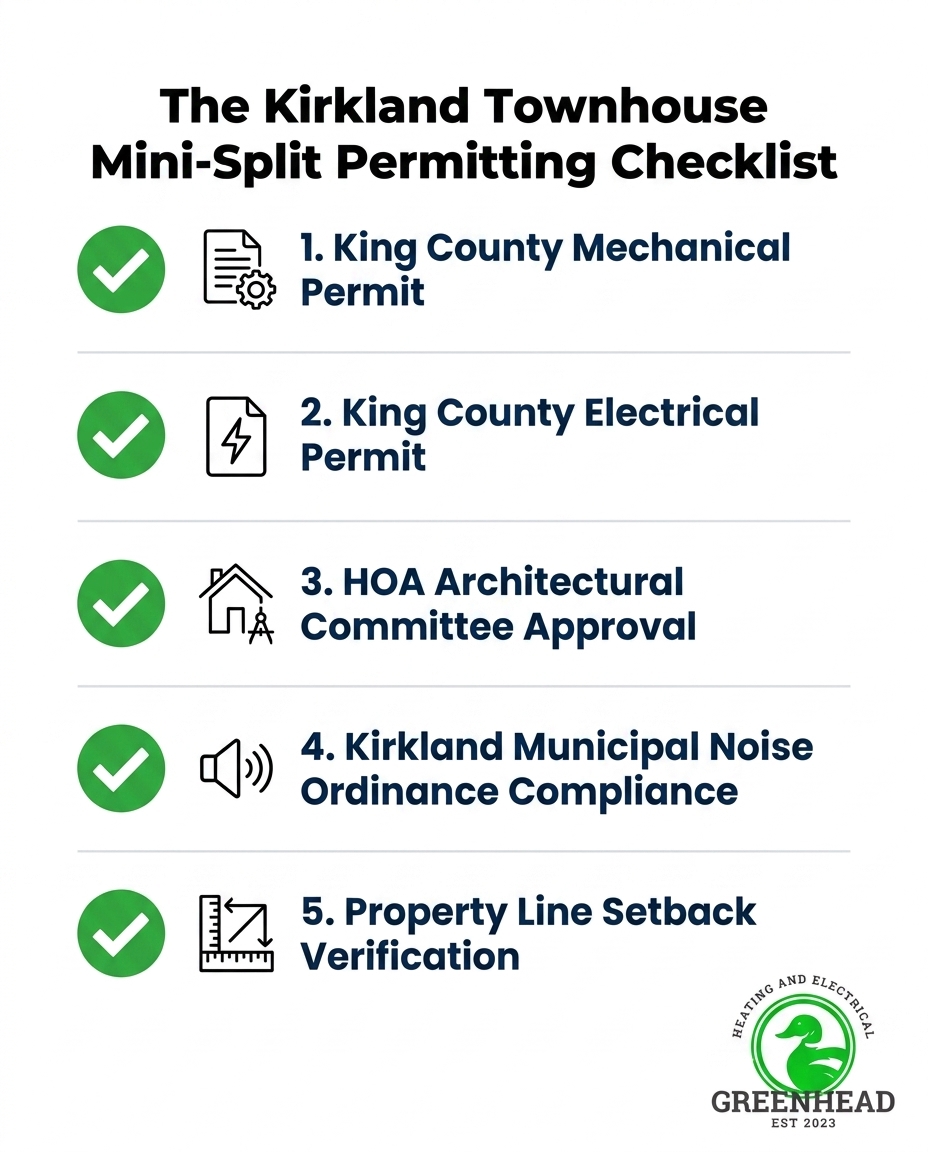
If your contractor submits a generic permit application without addressing all three of these layers, the project will be flagged. Anticipating these hurdles before the application is filed is a strategy we rely on to keep your timeline intact and ensure your home stays comfortable year-round.
Why Shared-Wall Properties Trigger Stricter King County Permit Hurdles
A pattern we see often in the HVAC industry is treating high-density townhomes exactly the same as detached single-family homes during the review process. King County does not view these structures equally. Because you share structural boundaries with your neighbors, the risks associated with electrical loads, structural modifications, and fire safety are significantly higher. When a standard contractor submits single-family paperwork for a townhouse project, it results in an immediate rejection.
Navigating these King County permit hurdles requires a deep understanding of local building codes. You can learn more about how we handle these regional requirements through our comprehensive Kirkland HVAC Services. The county requires detailed load calculations to prove that the shared structural walls can support the new equipment without compromising the building's integrity or fire safety ratings.
• Fire-Stopping Code — Detached Single-Family Home: Standard exterior wall penetrations. — Shared-Wall Townhouse: Strict fire-rated sealants required on all shared boundaries.
• Electrical Load — Detached Single-Family Home: Standard panel upgrade review. — Shared-Wall Townhouse: Complex heavy-up review due to shared grid infrastructure.
• Structural Review — Detached Single-Family Home: Basic equipment pad placement. — Shared-Wall Townhouse: Detailed load calculations for roof or bracket mounting.
• Application Rejection Rate — Detached Single-Family Home: Relatively low for standard installs. — Shared-Wall Townhouse: High if submitted without multi-family specific documentation.
The Dual-Permit Requirement for Ductless Systems
Installing a multi-zone ductless system almost always triggers a dual-permit requirement. First, you need a mechanical permit, which covers the refrigerant lines, the physical placement of the HVAC equipment, and the overall system design. Second, you need a separate electrical permit for the hardwired components.
The technical reality: Multi-zone systems draw significant power and require dedicated circuits. King County mandates that a licensed professional pull an electrical permit to ensure the new breakers, disconnect boxes, and wiring meet current safety standards. Trying to bypass the electrical permit or bundle it improperly with the mechanical permit is a guaranteed way to fail your final inspection.
Balancing Zero-Lot-Lines with Kirkland Municipal Noise Ordinances
Beyond county safety codes, townhouse owners must navigate strict local zoning laws. The City of Kirkland enforces specific exterior noise limits that are measured directly at the property line. For detached homes on large lots, the distance between the outdoor compressor and the neighbor's property naturally dissipates the sound. However, the geometric challenge of zero-lot-line or narrow townhouse boundaries makes placing a condenser much more difficult.
When your property line is only a few feet from your exterior wall, even a quiet modern compressor can push the decibel reading over the municipal limit. This requires strategic unit placement and acoustic dampening to pass municipal noise reviews. Moving the unit to a roof, utilizing a side alley, or installing specialized vibration isolators are all tactics our team uses to maintain compliance.
One of our recent clients experienced this exact challenge during a winter installation while we were replacing their aging gas furnace. They wanted to upgrade to a complex mini-split system featuring in-wall line sets and ceiling cassettes to maintain their home's clean aesthetic. Because of their tight Kirkland shared-wall townhouses layout, the outdoor unit placement threatened to violate local noise ordinances. By strategically routing the line sets within the walls, utilizing ultra-quiet ceiling cassettes, and addressing potential acoustic issues directly with the municipal inspectors through detailed pre-planning, we ensured the installation successfully passed the noise review without a hitch.
Acoustic dampening strategies that help pass inspection:
• Vibration isolation pads: Prevents the compressor from transferring low-frequency hums into the concrete pad or mounting brackets.
• Acoustic compressor blankets: Wraps the internal components to muffle mechanical noise before it escapes the cabinet.
• Strategic directional placement: Angling the fan discharge away from the neighbor's nearest window or property line.
• Micro-zoning: Using two smaller, quieter outdoor units instead of one massive, louder multi-zone compressor.
Proper planning ensures compliance without sacrificing system performance. It proves that you can achieve total indoor comfort without creating a nuisance for your neighbors.
When HOA Visual Screening Rules Collide with Climate Clearances
Even if you satisfy the county and the city, you still have to answer to your Homeowner Association. HOA architectural committees are notoriously strict about hiding exterior mechanical equipment. They often demand that outdoor condensers be placed behind heavy fencing, thick bushes, or custom enclosures to maintain the neighborhood's visual uniformity.
This creates a massive friction point. Manufacturers require specific airflow clearances around the outdoor condenser for safe, weather-resistant operation. If you choke the unit behind a solid fence, it will overheat, lose efficiency, and eventually fail. This is especially critical in our region. Kirkland's wet winters require specific outdoor unit clearances to prevent moisture damage and snow buildup, which frequently conflicts with strict townhouse HOA visual screening rules. If the unit cannot breathe, damp air gets trapped, leading to accelerated corrosion and ice accumulation on the coils.
The key to HOA approval: Negotiation through documentation. We always advise our clients that you cannot simply ask the HOA for permission; you must provide detailed site plans that satisfy both aesthetic and mechanical needs. For more insights on choosing equipment that fits tight spaces, review our Advanced HVAC System Selection Guide.
Submitting pre-approved architectural schematics is the best way to avoid HOA fines or forced relocations. A professional submission should include:
1. Scaled site maps: Showing the exact footprint of the unit relative to property lines and shared walls.
2. Manufacturer specification sheets: Highlighting the mandatory minimum airflow clearances to prove why a solid enclosure is dangerous.
3. Visual mockups: Demonstrating how louvered fencing or spaced landscaping will hide the unit while still allowing adequate cross-ventilation.
4. Decibel ratings: Proving that the chosen equipment operates below the HOA's noise threshold.
By presenting a well-researched, technically sound plan, you shift the conversation from a simple "yes or no" to a collaborative approval process, protecting your investment from future HOA disputes.
Navigating Structural and Electrical Panel Upgrades
The physical installation of a multi-zone system in a shared-wall property presents technical realities that go far beyond standard residential work. Routing refrigerant lines and condensate drains in townhouses without violating shared-wall fire ratings is a major undertaking. Building codes require that any penetration through a boundary wall—even for a small copper pipe—must be sealed with specific intumescent fire-stopping materials to prevent flames or smoke from traveling between units.
If you are experiencing issues with an older system that was improperly installed, professional Air Conditioning Repair Kirkland can help assess code violations. We frequently see older townhouses in the area that lack the electrical panel capacity for a modern 4-zone or 5-zone system. Many were built with 100-amp or 125-amp services, which are quickly maxed out by modern appliances, electric vehicle chargers, and new HVAC equipment.
Line Set Concealment and Fire Code Compliance
Exterior wall clutter is another major issue for townhouse owners. HOA rules usually prohibit running exposed plastic line-hide channels down the side of the building. To solve this, installers must route the lines internally. Using ceiling cassettes or slim ducted options allows the mechanical components to remain hidden, but it requires drilling through floor joists and fire-rated assemblies.
What an electrical heavy-up entails:
• Load calculations: Proving to the utility company that your home requires a 200-amp service upgrade.
• Panel replacement: Swapping out the old breaker box for a larger, modernized unit.
• Secondary inspections: An electrical heavy-up triggers additional local code compliance inspections separate from the HVAC work.
• Utility coordination: Scheduling the local power company to disconnect and reconnect service safely.
This level of complexity emphasizes the need for a contractor who understands both the HVAC and electrical codes. Disjointed inspection failures happen when the mechanical team and the electrical team are not perfectly aligned, leaving the homeowner stuck with a system they cannot legally turn on. Overcoming these King County permit hurdles requires seamless coordination.
Avoiding Bureaucratic Delays with End-to-End Permit Management
The standard industry practice for many contractors is to leave the permits to the homeowner. They provide the equipment and the labor, but they hand you a stack of blank county forms and tell you to get HOA approval on your own. In our experience, this approach almost always leads to disaster in a townhouse setting.
Positioning the turnkey handling of complex paperwork as the ultimate solution is the only way to avoid the administrative burden. Coordinating the mechanical permit, electrical permit, and HOA approval simultaneously shaves weeks off the timeline. When our team manages the paperwork end-to-end, we anticipate the King County permit hurdles before the inspector ever sets foot on the property.
One local customer came to us needing to install four mini-splits in their multi-story townhouse right before the intense summer heat arrived. They chose Greenhead Heating & Electrical LLC because we didn't just promise good equipment, but we also took full responsibility for obtaining all the necessary municipal and county permits. The installation was executed flawlessly, providing functional, zoned cooling that became an absolute blessing during the hottest weeks of the year—all without the homeowner having to fight with the city over paperwork.
The value of a single point of contact:
• Liability protection: Professional permit management protects the homeowner from unpermitted work penalties and future real estate disclosure issues.
• Faster approvals: Contractors who submit paperwork daily know exactly what the municipal reviewers are looking for.
• Unified scheduling: Coordinating the mechanical and electrical inspections back-to-back prevents project stall-outs.
• Peace of mind: You don't have to spend your lunch breaks arguing with the HOA architectural committee.
By choosing Greenhead Heating & Electrical LLC's turnkey service, you are taking advantage of our dual expertise in HVAC and electrical work to manage all King County and municipal paperwork end-to-end. This comprehensive approach ensures your townhouse upgrade is completed legally, safely, and on schedule. To keep your new system running perfectly after installation, regular AC Maintenance Kirkland is highly recommended.
Frequently Asked Questions About Kirkland Townhouse HVAC Permits
Do I need a permit to install a mini split in King County?
Yes, King County strictly requires permits for mini-split installations. You will generally need both a mechanical permit for the HVAC equipment and an electrical permit for the hardwired connections. Attempting to install a system without these permits can result in hefty fines, failed future home inspections, and potential safety hazards. Always work with a licensed professional who handles the permitting process for you.
Are ductless mini splits allowed in Kirkland townhouses?
Ductless mini splits are absolutely allowed in Kirkland townhouses, provided they meet all local regulations. The main challenges are ensuring the outdoor unit complies with municipal noise ordinances at the property line and satisfying your HOA's visual screening rules. Proper planning and strategic placement, such as using acoustic dampeners or roof mounts, make these installations highly successful in shared-wall properties.
Who is responsible for pulling HVAC permits in Washington state?
While a homeowner can technically pull their own permits, a reputable, licensed HVAC contractor should always pull the permits for the work they perform. When the contractor pulls the permit, they assume the liability for ensuring the work meets all state and county building codes. Leaving the permitting to the homeowner is a red flag that the contractor may not be fully licensed or bonded to perform the work.
What are the exterior noise regulations for HVAC in Kirkland?
The City of Kirkland enforces specific exterior noise limits to prevent mechanical equipment from disturbing neighbors. These limits are measured in decibels directly at the receiving property line. Because townhouses have very tight property lines, even standard HVAC equipment can sometimes exceed these limits without acoustic mitigation. Specialized vibration pads and strategic directional placement are often required to pass inspection.
How do zero-lot-line townhouse boundaries affect mini-split placement?
Zero-lot-line boundaries severely restrict where an outdoor condenser can physically sit. Because the property line often ends just inches from the exterior wall, placing a unit on the ground may violate setback zoning laws or block shared community pathways. Installers must often utilize wall-mounting brackets high off the ground, roof installations, or specialized slim-profile side-discharge units to fit the available space legally.
Does my HOA need to approve a ductless heat pump installation?
Almost all townhouse HOAs require formal architectural committee approval before you install a ductless heat pump. They want to review how the exterior condenser and the refrigerant line covers will alter the building's aesthetic. You will need to submit detailed site plans, equipment specifications, and visual mockups to prove the installation will not negatively impact the neighborhood's uniform appearance.
Streamline Your Townhouse Comfort Upgrade in King County
Successful installation in a shared-wall property requires mastering the paperwork just as much as the equipment. The overlapping layers of municipal noise ordinances, county electrical codes, and HOA architectural demands can quickly overwhelm a standard project. However, these hurdles are easily cleared with the right local partner who understands the unique landscape of Kirkland shared-wall townhouses.
You deserve a clear, localized explanation of the exact permit hurdles for your specific housing type, proving that an installer who manages the paperwork is critical to avoiding project delays. Do not let bureaucratic red tape keep you from enjoying a perfectly cooled home this summer. Reach out to our team at Greenhead Heating & Electrical LLC to handle both the technical installation and the bureaucratic heavy lifting, and schedule your AC Installation in Kirkland to experience true end-to-end service.
.svg)