Dual Fuel vs Straight Heat Pump: Why We Recommended a Hybrid System for a Recent Bellevue Install
The Myth of the Mandatory Electrical Upgrade for Heat Pumps
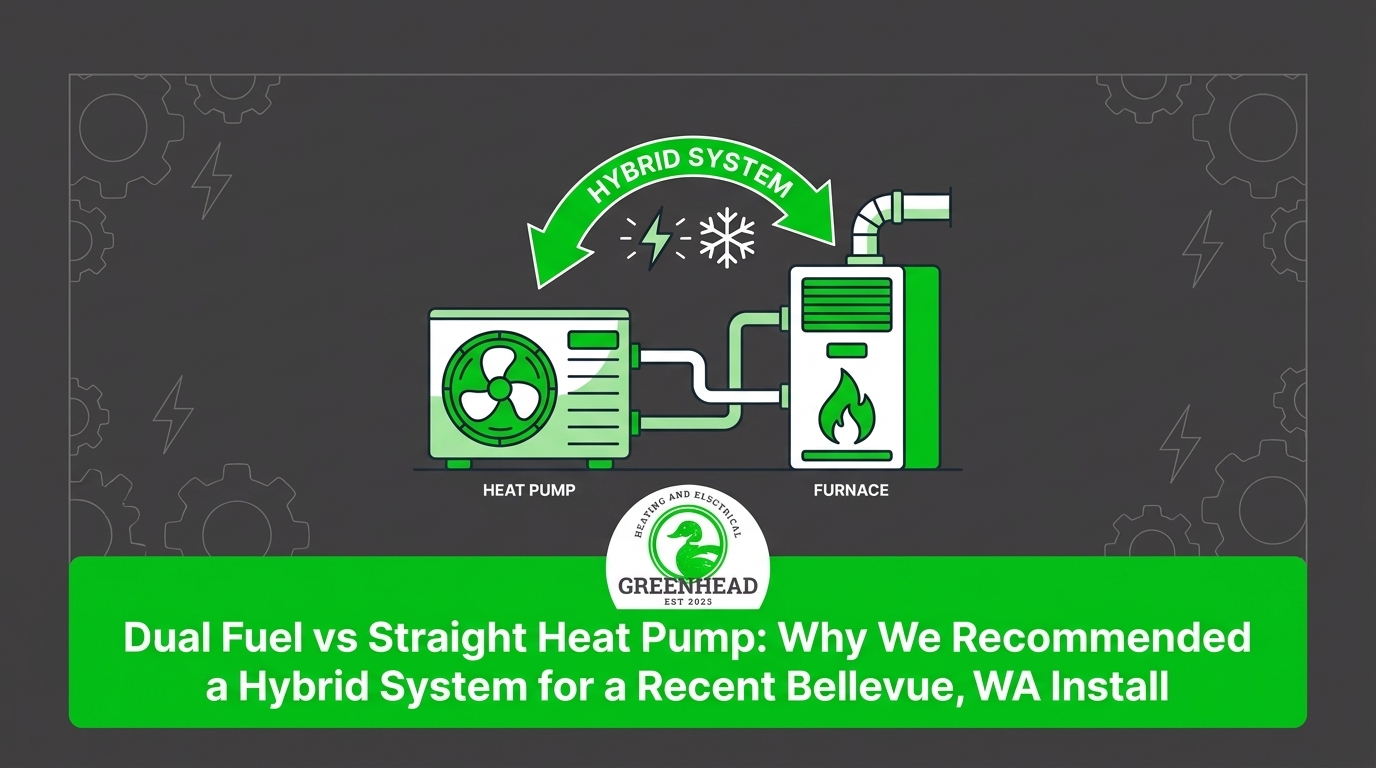
When Puyallup and Bellevue homeowners ask us about a Dual Fuel vs Straight Heat Pump: Why We Recommended a Hybrid System for a Recent Bellevue Install, the most common myth our team at Greenhead Heating & Electrical LLC encounters is that upgrading to a modern heat pump requires a complete overhaul of your home's electrical system. Many homeowners believe that ditching their old furnace for an energy-efficient heat pump automatically means tearing out their electrical panel and running heavy-gauge wire throughout the house. While heat pumps are incredibly efficient, this assumption often stops homeowners in their tracks before they even begin exploring their options.
As we perform early fall heating tune-ups across the Puget Sound region, this concrete problem usually surfaces. An older home desperately needs a heating upgrade before the winter chill sets in, but the existing electrical panel simply lacks the amperage capacity to support a straight heat pump's heavy electrical demands. This puts homeowners at a difficult decision point: do you pay for a major electrical service upgrade, or is there a way to utilize your existing gas infrastructure to create a highly efficient dual-fuel hybrid system?
The good news is that a strategic, whole-home assessment by our dual-trade professionals can reveal alternative pathways that keep your home warm without requiring a massive electrical overhaul. By evaluating your options carefully, you can modernize your heating services and enjoy the benefits of a heat pump while working within the constraints of your home's current infrastructure.
A Technical Case Study: Heating Upgrades in Bellevue's Older Homes
To understand how this plays out in the real world, it helps to look at our firsthand experience with the architectural and infrastructural reality of older residential homes in Bellevue and Puyallup. Over our years of serving the region, we've found that many of these houses were built decades ago, long before modern building codes anticipated the high electrical demands of today's appliances and HVAC systems. The structural layouts often feature tight crawlspaces and difficult-to-access attic spaces, making major rewiring projects both complex and disruptive.
During our typical September pre-heating season prep visits, a common pattern our technicians see involves homeowners looking to transition to a modern, energy-efficient heat pump system before the first major cold snap. For example, during one recent pre-winter project, a homeowner needed a heat pump for both heating and cooling in an older house with a very restrictive attic space. The initial goal was straightforward: modernize the primary heating source. However, our initial assessment quickly revealed a significant roadblock. The home's legacy electrical infrastructure was simply not robust enough to handle a standard, fully electric system.
By providing thorough explanations of the infrastructure limits and offering a practical workaround, our Greenhead Heating & Electrical team was able to successfully install a quiet and efficient new heat pump system on schedule. This approach highlights why understanding your home's hidden limitations is just as important as choosing the right equipment for a heat pump installation.
The Pre-Winter Prep Window
In our experience, timing plays a crucial role in these infrastructure upgrades. Early fall and September pre-heating season prep is the critical window for system changeouts. Waiting until the first freeze to discover that your electrical panel cannot support your new heating system leaves you in a vulnerable position.
1. Assessment phase: Identifying electrical bottlenecks while the weather is still mild.
2. Planning phase: Determining if a panel upgrade is necessary or if a hybrid workaround is viable.
3. Installation phase: Completing the physical work before emergency heating is required.
Tackling these technical hurdles in early fall ensures your home is fully prepared and comfortable long before the Pacific Northwest winter truly arrives.
The Hidden Hurdle: Legacy Electrical Panels vs. Auxiliary Heat
The primary reason a straight heat pump often triggers a mandatory panel upgrade comes down to a component called the auxiliary heat strip. While heat pumps are highly efficient at transferring heat from the outside air into your home, their efficiency drops when temperatures plummet. To prevent your home from getting cold during extreme weather or during the system's defrost cycle, straight heat pumps rely on electric resistance auxiliary heat strips.
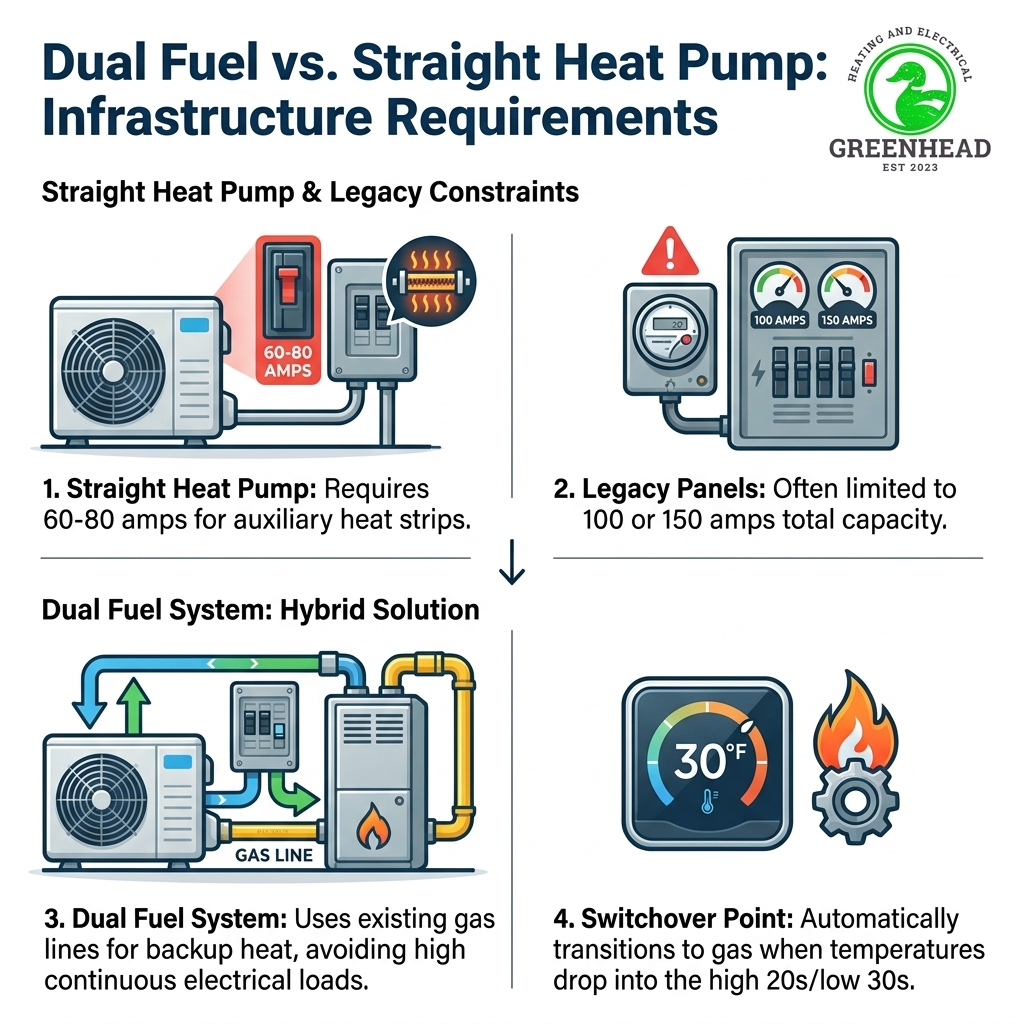
The problem: These emergency heat strips are essentially giant toasters inside your ductwork. They typically range from 15kW to 20kW in size. When they activate, they require a massive amperage draw—often pulling 60 to 80 amps all on their own.
The cause: Contrast this requirement with the capacity of older homes. Many legacy properties are equipped with 100-amp or 150-amp legacy electrical panels. If your panel only has 100 amps of total capacity, dedicating 80 amps just to your emergency heat leaves almost nothing for your lights, refrigerator, oven, or water heater. The National Electrical Code (NEC) sets strict load calculation standards to prevent overloaded circuits and fire hazards. Under these standards, adding a massive continuous load like a 20kW heat strip to a 100-amp panel is simply not permitted without a comprehensive upgrade.
The solution: This is where strategic planning comes in. If a straight heat pump overloads the panel, homeowners must look at alternatives that bypass the need for electric resistance heat entirely. This is often the point where our discussions pivot toward evaluating electrical panel upgrades versus alternative HVAC configurations.
Understanding Amperage Draw
To put this in perspective, electrical capacity is like a highway. Your panel determines how many lanes are available. Continuous loads—devices that run for three hours or more, like heating systems—take up dedicated lanes that cannot be used by anything else. Because the auxiliary heat is the primary culprit for overloading older panels, finding a way to heat your home without relying on electric resistance strips is the key to keeping your existing electrical infrastructure intact.
Dual Fuel vs. Straight Heat Pump: A Side-by-Side Comparison
When an electrical panel cannot support a fully electric system, the conversation naturally shifts to comparing a straight heat pump against a dual fuel, or hybrid, system. Understanding the fundamental differences between these two approaches clarifies why our team often finds the hybrid setup to be a much better fit for older infrastructure.
A straight heat pump is a 100% electric system. It handles both heating and cooling, but it relies entirely on those high-draw electric heat strips for extreme cold weather backup. A dual fuel system, on the other hand, pairs an electric heat pump with a gas furnace. The heat pump handles the cooling in the summer and the heating during moderate weather. When the temperature drops too low for the heat pump to operate efficiently, the system automatically shuts off the heat pump and turns on the gas furnace to provide the backup heat.
• Primary Heat Source — Straight Heat Pump: Electric Heat Pump — Dual Fuel (Hybrid) System: Electric Heat Pump
• Backup Heat Source — Straight Heat Pump: Electric Resistance Strips (15kW-20kW) — Dual Fuel (Hybrid) System: Natural Gas Furnace
• Electrical Demand — Straight Heat Pump: High (Requires 60-80 dedicated amps for backup) — Dual Fuel (Hybrid) System: Low (Furnace fan uses minimal amperage)
• Infrastructure Impact — Straight Heat Pump: Often requires a heavy panel upgrade in older homes — Dual Fuel (Hybrid) System: Utilizes existing gas lines; avoids panel upgrades
• Installation Scope — Straight Heat Pump: Requires pulling new heavy-gauge electrical wire — Dual Fuel (Hybrid) System: Leverages existing ductwork and gas connections
By comparing the electrical load footprint of both systems, the advantage of the hybrid approach becomes clear. The dual fuel system completely eliminates the need for the 60 to 80 amp electric heat strips. Instead, it uses the home's existing gas line to generate backup heat, requiring only a fraction of the electricity to run the blower motor.
Pros and Cons for Older Infrastructure
• Straight Heat Pump: Offers excellent overall efficiency and completely eliminates fossil fuels from the home. However, the high electrical infrastructure demands often make it cost-prohibitive for homes with 100-amp panels.
• Dual Fuel System: Avoids the need for expensive panel upgrades, utilizes existing gas infrastructure, and remains highly adaptable to changing weather conditions. The main drawback is that it still requires an active gas connection.
Why the Hybrid Approach Fits the Pacific Northwest Climate
Beyond the electrical constraints, our local installers frequently recommend the dual fuel system because it optimally handles the specific weather patterns of the Pacific Northwest. Bellevue and Puyallup experience chilly, damp winters where temperatures frequently dip near freezing. We rarely see the extended sub-zero deep freezes common in the Midwest, but we do experience prolonged periods of cold, wet weather that can challenge a standard heat pump's efficiency.
Modern dual-fuel systems are programmed with a specific temperature threshold, usually set in the high 20s to low 30s Fahrenheit. When the outdoor temperature is above this threshold, the heat pump operates at peak efficiency, pulling ambient heat from the air to warm your home. Because our early fall and mild winter days often hover in the 40s and 50s, the heat pump handles the vast majority of the heating season.
However, when a freezing snap hits and temperatures drop below that threshold, the system automatically switches over to the gas furnace. This switchover provides fast, efficient comfort right when this specific climate demands it. Gas heat is exceptionally good at quickly raising indoor temperatures during damp, freezing weather.
Most importantly, this climate-specific operation perfectly aligns with avoiding the high-amp electric heat strips. By letting the gas furnace take over during the coldest nights, you get the robust heating power you need without overwhelming your electrical panel. For homeowners exploring HVAC services in Bellevue, this hybrid approach offers the perfect balance of efficiency and reliability tailored specifically to local weather patterns.
The Value of a Whole-Home Infrastructure Assessment
One of the biggest pitfalls in home heating upgrades is scope creep. Often, HVAC-only contractors focus entirely on the heating equipment and overlook the electrical constraints until the project is already underway. It is incredibly frustrating to have your old furnace removed, only to be told that the new heat pump cannot be hooked up until you hire an electrician to perform a major panel upgrade.
Because our team at Greenhead Heating & Electrical LLC handles both HVAC and electrical services under one roof, we assess the entire home's infrastructure upfront. Evaluating the existing heating equipment and the electrical panel together during the initial consultation prevents these expensive surprises. In another typical September scenario, a homeowner needed a new AC and furnace installation. By providing outstanding advice and evaluating their existing equipment and panel capacity beforehand, our team recommended a great hybrid solution. This comprehensive approach allowed us to complete a high-quality installation quickly and on schedule, without triggering an unexpected electrical overhaul.
This dual-trade expertise leads to honest, practical recommendations that save homeowners from surprise major overhauls. We identify the hidden electrical upgrade requirements of straight heat pumps that others might miss, making the dual-fuel system a strategic, planned workaround rather than a last-minute compromise.
Additionally, choosing a hybrid system doesn't mean missing out on efficiency incentives. Generic energy rebates and federal tax credits often still apply to qualifying high-efficiency dual-fuel heat pump installations, making them a smart long-term choice. We always advise homeowners to review a comprehensive guide to choosing the right HVAC system and verify current incentive programs with their utility provider or a tax professional to maximize their investment.
Frequently Asked Questions About Heat Pumps and Electrical Panels
Does a heat pump require an electrical panel upgrade?
It depends entirely on your home's current electrical capacity and the type of heat pump you choose. A straight heat pump relying on electric resistance auxiliary heat often requires a panel upgrade in older homes with 100-amp or 150-amp service. However, as we often advise our clients, choosing a dual fuel system that uses gas for backup heat can usually bypass the need for an electrical upgrade.
How does a dual fuel heat pump work?
A dual fuel heat pump combines an electric heat pump with a gas furnace. During mild weather, the heat pump efficiently warms your home by transferring heat from the outside air. When temperatures drop to near freezing, the system automatically shuts off the heat pump and activates the gas furnace to provide powerful, consistent backup heat.
Why choose dual fuel over a straight heat pump?
The primary reason to choose a dual fuel system is to avoid the massive electrical demands of a straight heat pump's emergency heat strips. It allows homeowners with older electrical panels to enjoy the efficiency of a heat pump without paying for a major electrical service upgrade, while still ensuring reliable warmth during freezing weather.
What is the downside to a dual fuel heat pump?
The main downside is that a dual fuel system requires an active natural gas or propane connection to operate the backup furnace. If your goal is to completely disconnect from fossil fuels and fully electrify your home, a dual fuel system will not achieve that objective, and you will likely need to budget for an electrical panel upgrade instead.
How many amps does auxiliary heat draw on a straight heat pump?
The electric resistance auxiliary heat strips used in straight heat pumps typically draw between 60 and 80 amps when activated. Because this is a continuous load, it consumes a massive portion of an older home's total electrical capacity, which is why our electricians so often see it trigger the need for a panel upgrade.
Secure the Right Heating Solution for Your Home's Infrastructure
Understanding your options is the first step toward modernizing your home's heating without falling victim to unnecessary electrical overhauls. A dual-fuel system offers a brilliant workaround, utilizing existing gas lines for backup heat so you can enjoy the efficiency of a heat pump without overwhelming your legacy electrical panel.
Before the winter weather hits, the most important thing you can do is secure a comprehensive, dual-trade assessment of both your HVAC and electrical systems. Schedule an evaluation with our local Greenhead Heating & Electrical experts today, and get a clear, honest picture of exactly how a hybrid system can work around your home's unique limitations to provide reliable, efficient comfort all season long.
.svg)