Comparing Cold-Climate Mini-Splits: Why Hyper-Heating Tech Wins in the Pacific Northwest

The October Pre-Winter Dilemma: Preparing for Sub-Freezing Temperatures
With October's chill settling in, the window for pre-winter heating startups is closing fast before the severe November and December weather shifts arrive. At Greenhead Heating & Electrical, we find that when homeowners are researching and Comparing Cold-Climate Mini-Splits: Why Hyper-Heating Tech Wins in the Pacific Northwest, the decision usually comes down to one concrete problem: standard heat pumps risk losing significant heating capacity when temperatures drop. As you prepare for the damp, freezing PNW winter cold snaps, you face a critical decision point. Is the extra investment in hyper-heating technology actually justified for your home, or will a standard system suffice? True winter comfort requires understanding exactly how different technologies handle our unique regional climate, rather than just looking at generic national ratings.
For expert guidance on your options, explore our heating services to ensure your home is ready for whatever winter brings.
The Damp Cold Challenge: Why Pacific Northwest Winters Defy Standard Metrics
When our team evaluates heating systems across Puyallup, WA, we constantly remind homeowners that not all cold weather behaves the same way. In regions like the Midwest, winter often brings extreme dry cold. Heat pumps operating in dry air face different challenges than those operating in the Pacific Northwest. Here, winter typically delivers a heavy, moisture-laden cold. Temperatures frequently hover between 25 and 35 degrees Fahrenheit, accompanied by high humidity, rain, and sleet.
The problem with damp cold: High humidity combined with freezing temperatures creates the perfect environment for rapid frost buildup on outdoor heat pump coils. As the outdoor unit attempts to extract ambient heat from the air, the moisture condenses and freezes almost instantly on the metal fins.
The cause of system strain: We routinely see standard mini-splits that are heavily marketed as "good enough" for mild climates struggle immensely during intense local cold snaps. While they perform beautifully during a crisp 45-degree autumn day, the heavy frost forces standard units to work twice as hard to pull heat through a layer of ice, drastically reducing efficiency and heating output.
The solution through proper evaluation: Evaluating heating systems based solely on standard ambient temperature ratings can be highly misleading for this region. A unit rated to operate down to 5 degrees in dry conditions might fail to keep your living room warm at 28 degrees in heavy freezing rain. Understanding this damp cold challenge is the first step in recognizing why our technicians so frequently recommend specialized equipment for consistent comfort.
Standard Mini-Splits vs. Hyper-Heating Inverter Technology
To truly understand the difference in performance during damp, freezing PNW winter cold snaps, we often show our customers what is under the hood regarding compressor technology. Standard mini-splits utilize conventional inverter-driven compressors. These are highly efficient in moderate weather, but as the temperature drops toward freezing, the refrigerant pressure drops, and the system physically cannot move enough heat indoors.
If you are weighing a standard ducted heat pump vs ductless mini-splits, it is critical to factor in hyper-heating inverter technology. Hyper-heating models (often referred to as cold-climate heat pumps) are engineered with enhanced compressors designed specifically to overcome the pressure drops associated with freezing weather.
• Heating Capacity at 32°F — Standard Mini-Split: Begins dropping (often to 70-80% of rated capacity) — Hyper-Heating (Cold-Climate) Mini-Split: Maintains 100% of rated heating capacity
• Heating Capacity at 5°F — Standard Mini-Split: Severely reduced (often below 50%) or shuts down — Hyper-Heating (Cold-Climate) Mini-Split: Maintains 100% of rated heating capacity
• Compressor Technology — Standard Mini-Split: Standard variable-speed inverter — Hyper-Heating (Cold-Climate) Mini-Split: Enhanced flash-injection variable-speed inverter
• Efficiency Loss in Rapid Temp Drops — Standard Mini-Split: High loss of efficiency; relies on backup heat sooner — Hyper-Heating (Cold-Climate) Mini-Split: Minimal loss; algorithms adjust compressor speed dynamically
How Flash-Injection Compressors Work
The secret behind a cold-climate mini-split's ability to maintain total heating capacity at sub-freezing temperatures is flash-injection technology. Here is how this advanced engineering bypasses traditional refrigerant flow limitations to keep your home comfortable:
• Two-phase refrigerant injection: Instead of relying on a single cycle, the compressor injects a mixture of liquid and gas refrigerant directly into the compression chamber.
• Increased mass flow rate: This injection allows the system to circulate a higher volume of refrigerant even when outdoor ambient heat is scarce, delivering more heat to the indoor coil.
• Sustained high efficiency: By keeping the compressor operating at optimal pressures, hyper-heating models maintain high Heating Seasonal Performance Factor (HSPF) ratings in real-world freezing conditions, preventing the massive efficiency drop-offs we typically see in standard units.
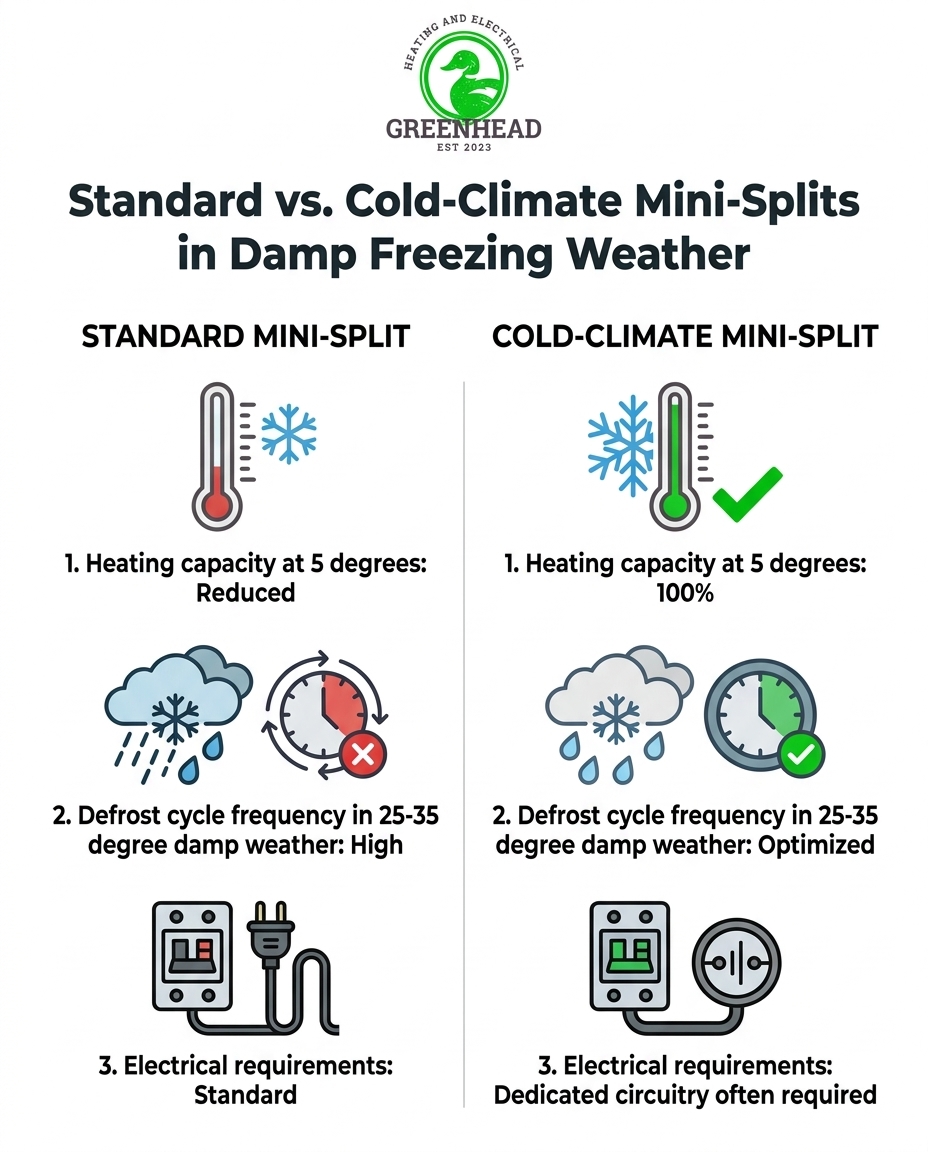
Defeating the Defrost Cycle: Managing Moisture in Freezing Weather
In our experience, one of the most misunderstood aspects of heat pump operation is the defrost cycle. When a heat pump operates in heating mode during the winter, the outdoor coil acts as an evaporator, becoming extremely cold—often colder than the outside air. In the damp, freezing PNW winter cold snaps, the heavy moisture in the air condenses onto this freezing coil and rapidly turns to ice.
To prevent the outdoor unit from turning into a solid block of ice, the heat pump must periodically initiate a defrost cycle. It temporarily reverses its operation, switching back into cooling mode. This sends hot refrigerant to the outdoor coil to melt the ice. During this time, the indoor unit stops blowing warm air. In fact, standard units often blow lukewarm or distinctly cold air into your living space while they try to thaw the outdoor unit.
The impact of high moisture: Because Pacific Northwest winters are so wet, our service calls often involve standard heat pumps that accumulate frost much faster than they would in a dry climate. This causes standard units to get stuck in frequent, inefficient defrost cycles. You might notice the system spending 10 to 15 minutes every hour trying to thaw itself out, leaving your home feeling chilly and uncomfortable.
The hyper-heating advantage: Cold-climate models utilize advanced sensors, specialized coil coatings, and smarter algorithms to manage moisture. They can accurately detect the difference between a light frost and a restrictive ice buildup, delaying the defrost cycle until it is absolutely necessary. When they do enter defrost, the flash-injection compressor ramps up to execute the thaw incredibly fast, minimizing downtime and maximizing the amount of warm air delivered to your home.
The Hidden Requirement: Electrical Infrastructure for High-Performance Heating
A crucial factor that many homeowners overlook when upgrading to hyper-heating technology is the electrical demand. These units are incredibly powerful, and that performance requires proper electrical infrastructure. Hyper-heating units draw different electrical loads than standard units to power their advanced flash-injection compressors and integrated base-pan heaters.
Because the team at Greenhead Heating & Electrical brings dual expertise in both HVAC and electrical systems, we ensure that your home has the proper panel capacity and safe wiring for these powerful units. You never want to discover that your new high-performance heating system trips your main breaker every time a cold snap hits. Proper preparation involves several critical steps:
1. Evaluating panel capacity: Before selecting a hyper-heating model in Puyallup, WA, our experts assess your main electrical panel to ensure it has the available amperage to support the new equipment alongside your existing household appliances.
2. Planning dedicated circuitry: High-performance HVAC equipment requires dedicated circuits. Sharing a circuit with other high-draw appliances can lead to voltage drops, tripped breakers, and potential fire hazards.
3. Assessing wiring integrity: Older homes may have outdated wiring that cannot safely carry the sustained loads required during a multi-day winter freeze. Upgrading the wiring from the panel to the outdoor disconnect is often necessary.
4. Integrated installation: Having our single-source experts handle both the mechanical installation and the electrical upgrades ensures that the system is safely commissioned and calibrated to operate at peak efficiency from day one.
Ignoring these electrical requirements can lead to premature equipment failure, voided warranties, and significant safety risks. The right technology is only as reliable as the power grid supporting it.
Retrofitting Older Homes for Winter Readiness
Updating older homes with modern, efficient heating without destroying the aesthetic or losing valuable floor space is a common challenge we tackle. Historic properties and mid-century builds often lack the ductwork necessary for central forced air, making ductless systems the ideal solution. However, routing these systems through tricky spaces like tight attics, plaster walls, and narrow crawlspaces requires careful planning.
Multi-zone hyper-heating systems offer incredible flexibility for these challenging architectural layouts. Last fall, our installation team worked with a Puyallup, WA homeowner who needed a complex multi-zone mini-split system but faced strict placement and aesthetic constraints. They wanted concealed line sets to preserve the home's exterior look and had tricky condenser placement requirements due to neighborhood noise restrictions. Our solution involved designing a custom layout utilizing ceiling cassettes and running the lines inside the walls. Ultimately, the multi-zone system was successfully installed, passed the property noise review with flying colors, and provided a massive upgrade in winter readiness.
The importance of professional design: This level of seamless integration highlights that proper installation is just as critical as the equipment technology itself. A poorly placed indoor head will create hot and cold spots, while a poorly located outdoor condenser can vibrate against the home's framing. Professional retrofitting ensures quiet operation, even heat distribution, and maximum efficiency gains.
Avoiding the Trap of Inefficient Emergency Backup Heat
When standard heat pumps fail to keep up with dropping temperatures, they rely on secondary heating sources. In many homes, this means emergency electric resistance heat strips kick on. While heat strips will certainly warm your home, they come with a massive hidden cost.
Electric resistance heat operates with a Coefficient of Performance (COP) of 1.0, meaning for every unit of electricity consumed, it produces exactly one unit of heat. By contrast, a hyper-heating mini-split can operate with a COP of 2.5 or higher even in sub-freezing temperatures, producing two and a half times more heat for the same amount of electricity. We have seen too many homeowners rely on backup heat strips during a week-long cold snap in Puyallup, WA, causing their winter utility bills to skyrocket unexpectedly.
A properly sized cold-climate mini-split eliminates the need for these expensive secondary heating sources. By maintaining 100% capacity down to 5 degrees, the hyper-heating system handles the entire heating load efficiently. Additionally, upgrading to high-efficiency cold-climate heat pumps may qualify for federal tax credits or local utility incentive programs. While you should always verify current programs with your utility provider or a tax professional, these incentives can help offset the initial installation costs.
Ultimately, the upfront investment in hyper-heating pays dividends in consistent comfort, lower monthly operating costs, and the peace of knowing you won't be left shivering when the temperature plummets. When you are ready to secure your home, reaching out to our trusted Puyallup heating experts ensures you get a system tailored exactly to your home's thermal load.
Addressing Common Cold-Climate Heat Pump Questions
Navigating the technical specifications of modern HVAC equipment can be overwhelming. To help clarify the decision-making process, here are answers to the most common questions our customers ask when preparing for damp, freezing PNW winter cold snaps.
What is the difference between a standard mini-split and a cold climate mini-split?
The primary difference lies in the compressor technology and low-temperature performance. Standard units begin to lose significant heating capacity when temperatures drop below freezing, often requiring backup heat. Cold climate units utilize advanced flash-injection compressors to maintain 100% of their rated heating capacity down to sub-freezing temperatures, ensuring your home stays warm without relying on inefficient secondary heating sources.
Does a hyper heat mini-split require a dedicated circuit?
Yes, high-performance hyper-heating units require proper electrical panel capacity and dedicated circuitry for safe, efficient operation. Because they utilize advanced compressors and often include base-pan heaters to prevent ice buildup, they draw specific electrical loads that cannot safely share a circuit with other household appliances. Our team always performs a professional load calculation before installation.
Why is my heat pump freezing up in the winter?
High moisture combined with freezing temperatures causes rapid coil frosting on the outdoor unit. In damp climates, standard units struggle to manage this heavy frost, leading to inefficient, continuous defrost cycles where the system temporarily stops heating your home to melt the ice. Cold-climate models use smarter sensors to minimize frost buildup and execute much faster defrost cycles.
Do I need a cold climate heat pump in Washington state?
While the overall Pacific Northwest climate is generally classified as mild, our specific damp, freezing cold snaps make cold-climate models highly recommended. The heavy moisture in the air creates unique challenges for standard heat pumps. Investing in hyper-heating technology ensures you maintain consistent indoor comfort and avoid the high operating costs associated with relying on emergency electric backup heat.
At what temperature do standard mini splits stop working effectively?
Most standard mini-split units begin losing significant heating capacity and efficiency when outdoor temperatures drop below freezing (32 degrees Fahrenheit). By the time temperatures reach the low 20s, a standard unit may only be producing a fraction of its rated heat, forcing your home's backup heating system to take over the heavy lifting.
Secure Your Winter Comfort: Comparing Cold-Climate Mini-Splits: Why Hyper-Heating Tech Wins in the Pacific Northwest
As the winter weather approaches, making the right choice for your home's climate control is vital. Comparing Cold-Climate Mini-Splits: Why Hyper-Heating Tech Wins in the Pacific Northwest ultimately comes down to reliability during our specific weather events. Hyper-heating models perform fundamentally differently in damp, sub-freezing weather compared to standard units, overcoming heavy frost and maintaining total heating capacity when you need it most.
Reiterating the importance of evaluating both your mechanical HVAC needs and your home's electrical capacity cannot be overstated. A high-performance system requires a solid foundation to operate safely and efficiently. By choosing advanced technology, you eliminate the reliance on expensive backup heating and secure consistent comfort throughout the damp, freezing PNW winter cold snaps.
Now is the time to talk to our experts at Greenhead Heating & Electrical and make an informed pre-winter investment decision. Secure your winter comfort today by scheduling a professional ductless mini-split installation consultation tailored to your home's unique layout and electrical capacity.