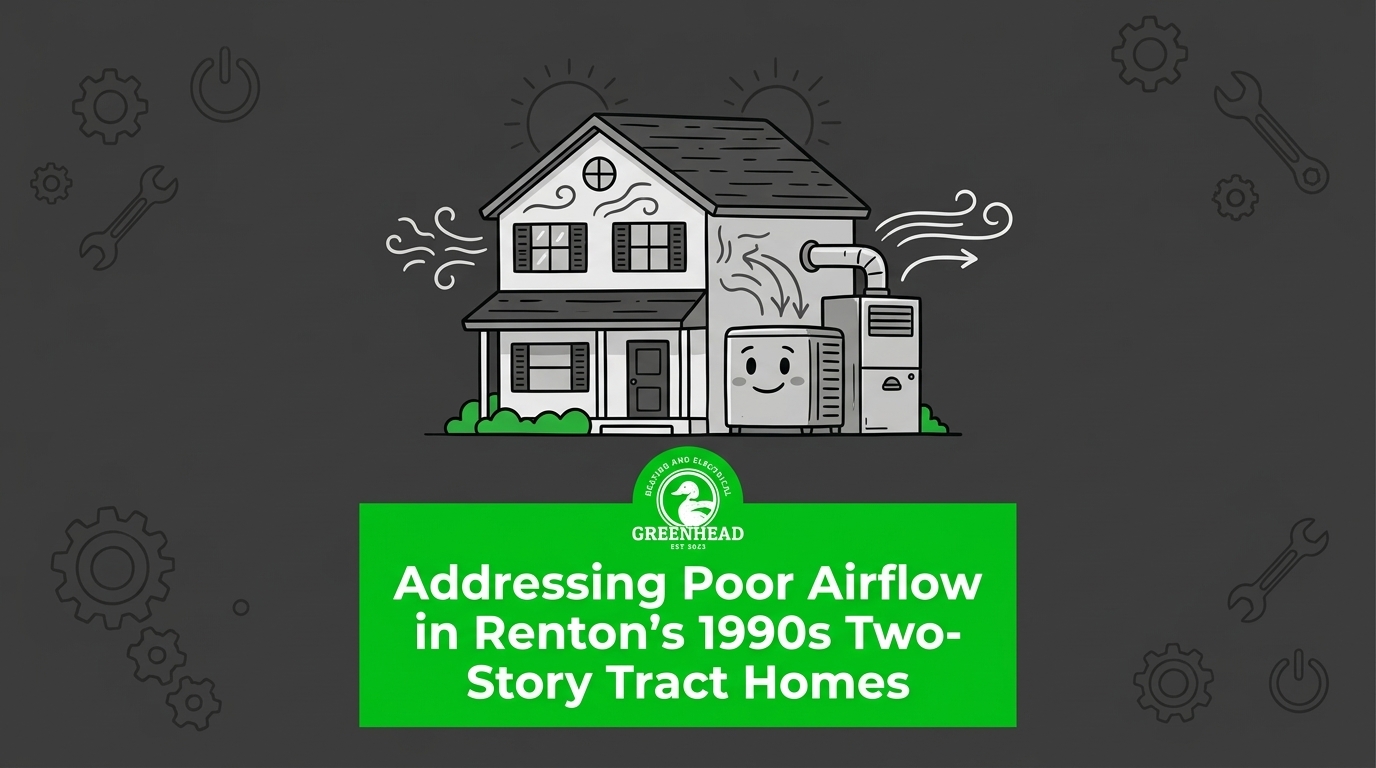
Addressing Poor Airflow in Renton's Two-Story Tract Homes
The Chilly Reality of Two-Story Homes During Fall Startup
Your downstairs thermostat reads a cozy 70 degrees, but the moment you walk up the stairs, the temperature drops noticeably. Addressing Poor Airflow in Renton's Two-Story Tract Homes is a common challenge, especially when the crisp October heating startup begins. You turn on the furnace for those first chilly fall nights, expecting warmth to spread evenly throughout the house. Instead, the upstairs bedrooms remain freezing, leaving you pulling out extra blankets and wondering if your heating equipment is already failing. In our years of providing HVAC solutions throughout Puyallup and Renton, our team at Greenhead Heating & Electrical LLC sees this exact scenario play out every October.
Ready to fix your freezing second floor? Learn more about our comprehensive HVAC services in Renton.
Many homeowners assume their furnace is broken when they experience this drastic temperature difference. However, we often find that the real culprit is rarely a malfunctioning heater. In most cases, it is a structural airflow issue baked directly into the home's original architectural design. The blower motor is working exactly as intended, but the pathways delivering that warm air are fundamentally flawed.
When faced with this frustrating imbalance, you encounter a clear decision point. You can continue wasting time on ineffective do-it-yourself fixes that yield no real results, or you can invest in professional diagnostics to uncover the root cause. Resolving this specific architectural flaw requires moving beyond basic maintenance and looking closely at how air travels from your basement or garage all the way up to your second-floor ceiling.
Why 1990s Builder-Grade Ductwork Fails the Second Floor
To understand why your upstairs bedrooms are so cold, you have to look back at the rapid housing boom in King County during the late twentieth century. When our technicians inspect 1990s Renton subdivisions, we consistently find that standard builder-grade ductwork was installed to meet tight construction timelines. While these systems met the minimum building codes of the era, they often failed to account for the complex physics of pushing conditioned air through long vertical runs.
The physics of heating a two-story home are inherently challenging. Warm air naturally rises, but it must be forcefully pushed through ductwork to reach the registers. In a typical builder-grade layout, the furnace is located on the ground floor or in the garage. As the heated air travels up the long vertical duct runs inside the walls, significant heat loss occurs. By the time the air finally reaches the second-floor registers, it has lost much of its velocity and warmth.
Furthermore, we routinely notice these original designs suffer from undersized or entirely missing return air vents in the upstairs bedrooms. Return vents are responsible for pulling stale air back to the furnace to be reheated. If an upstairs bedroom lacks a return vent, pushing new warm air into that room is like trying to blow air into a glass bottle that is already full. The air simply cannot circulate properly, resulting in stagnant, cold pockets.
A common misconception we hear is that simply upgrading to a larger furnace will solve the problem. Unfortunately, installing a more powerful blower motor cannot overcome the friction and static pressure limitations of undersized original ducts. For a permanent solution, homeowners must look toward professional duct design rather than just swapping out equipment.
• Trunk Line Sizing — 1990s Builder-Grade Ductwork: Often undersized to fit narrow wall cavities. — Professional Modern Duct Design: Calculated precisely to minimize static pressure.
• Return Air Pathways — 1990s Builder-Grade Ductwork: Limited to a single central hallway return. — Professional Modern Duct Design: Dedicated return vents in every enclosed bedroom.
• Vertical Runs — 1990s Builder-Grade Ductwork: Long, uninsulated runs prone to heat loss. — Professional Modern Duct Design: Strategically routed and insulated for temperature retention.
• Airflow Balancing — 1990s Builder-Grade Ductwork: Standardized dampers, rarely adjusted per room. — Professional Modern Duct Design: Custom balanced to ensure equal distribution upstairs.

The Hidden Dangers of Closing Downstairs Vents
When the October heating startup reveals a freezing second floor, the most common instinct we see homeowners try is to walk through the first floor and shut all the supply registers. The logic seems sound: if you block the air from entering the downstairs living room, it will be forced to travel upstairs to the bedrooms. However, our technicians constantly have to warn against this do-it-yourself approach because it is entirely ineffective for structural airflow issues and actively damages your heating equipment.
Modern HVAC blower motors are engineered to operate against specific static pressure limits, following strict industry guidelines like ASHRAE standards. Static pressure is the resistance to airflow within your duct system. When you close registers, you are not redirecting air in a helpful way; you are simply increasing the resistance the blower motor has to fight against. The system is designed to breathe a specific volume of air, and choking off the supply vents suffocates the equipment.
The consequences of high static pressure we frequently repair include:
• Overheated heat exchangers: When airflow slows down due to closed vents, the heat exchanger cannot dissipate its heat fast enough. This causes the furnace to overheat and cycle off prematurely on its high-limit safety switch.
• Frozen evaporator coils: If you utilize this same vent-closing tactic during the summer, the lack of airflow causes the indoor coil to freeze solid, completely halting the cooling process.
• Premature blower motor failure: Forcing a blower motor to push air against closed vents causes it to overwork, draw excessive electrical current, and eventually burn out years before its expected lifespan.
• Increased energy consumption: Because the system is straining against high pressure, it uses significantly more electricity or gas to achieve the same amount of heating, driving up your utility bills.
Ultimately, closing downstairs vents does not fix bad ductwork. It merely shifts a structural problem into an expensive mechanical failure.
How Pacific Northwest Weather Amplifies Airflow Imbalances
The structural ductwork flaws found in 1990s Renton subdivisions are noticeable in any climate, but living and working in the Pacific Northwest, our team knows firsthand how the damp, cool weather amplifies these issues. As fall transitions into winter, the region experiences prolonged periods of damp, cool weather. This high ambient humidity significantly alters how cold temperatures feel inside your home.
When airflow is weak and upstairs bedrooms lack proper return vents, the air becomes stagnant. In a damp climate, stagnant air traps indoor moisture generated from breathing, showering, and cooking. This excess moisture often manifests as heavy condensation pooling on second-floor windows. Because humid air feels colder to the human body than dry air at the exact same temperature, a bedroom that is mathematically only a few degrees cooler than the downstairs will feel uncomfortably freezing.
This localized climate challenge means that overcoming airflow imbalances is not just about temperature; it is about proper ventilation and moisture management. Without adequate air circulation to move that damp, heavy air back to the central system for conditioning, your second floor will always feel clammy and uncomfortable during the winter months.
Furthermore, this structural strain is not limited to the heating season. The exact same undersized ducts that fail to push warm air upstairs in October will fail to push cool air upstairs in July. Consistent, year-round system care and professional Renton AC maintenance are critical for these homes, as the equipment is constantly fighting an uphill battle against its own ductwork.
Professional Diagnostics: Going Beyond the Air Filter
Bridging the gap between dealing with freezing bedrooms and actually fixing the problem requires a professional evaluation. While changing your air filter regularly is a great habit, it will not solve a structural deficiency. Identifying the exact bottlenecks in a builder-grade system is the only way to prescribe an accurate, permanent fix.
Working with a team like ours that has deep local expertise in diagnosing and retrofitting 1990s builder-grade ductwork specific to Renton area subdivisions ensures that the evaluation targets the right variables. When Greenhead Heating & Electrical LLC conducts a comprehensive diagnostic, it goes far beyond shining a flashlight into a vent. It involves precise measurements and a thorough understanding of fluid dynamics as they apply to residential construction.
A professional airflow diagnostic from our technicians typically includes:
1. Static Pressure Testing: We use a manometer to measure the exact resistance inside the supply and return plenums. This provides a clear mathematical picture of how hard the blower motor is working and whether the ductwork is undersized.
2. Evaluating Vertical Runs: Our professionals inspect the accessible portions of the vertical duct runs to check for severe bends, crushed sections, or disconnected joints that might be bleeding warm air into the wall cavities before it reaches the second floor.
3. Return Air Assessment: We measure the total volume of return air available to the system, specifically checking if the upstairs bedrooms have an adequate pathway for stale air to escape.
4. Temperature Differential Mapping: By measuring the temperature of the air as it leaves the furnace and comparing it to the temperature at the upstairs registers, we can calculate exactly how much heat is being lost in transit.
Understanding these metrics is why evaluating existing ductwork is a mandatory step before assuming a complete furnace or heat pump replacement is necessary. Putting a brand-new, high-efficiency furnace onto restrictive 1990s ductwork will only result in a newer, more expensive system suffering from the exact same airflow problems.
Structural Retrofits vs. Supplemental Heating Solutions
Once our diagnostic phase reveals the specific limitations of the ductwork in 1990s Renton subdivisions, homeowners have several professional paths forward. We tailor the right solution based on the home's exact layout, the accessibility of the existing ducts, and the family's long-term comfort goals.
Ductwork Modifications
If the existing ductwork is accessible—such as through an unfinished basement or a large attic space—structural retrofits can directly address the friction points. This often involves expanding the main trunk lines to reduce the velocity and static pressure of the air leaving the furnace. By giving the air a wider pathway, the system can move a larger volume of air with less resistance.
Another critical modification is adding dedicated return air pathways from isolated upstairs bedrooms. If running new ductwork all the way to the basement is impossible, our professionals can sometimes install transfer grilles above bedroom doors. These allow stagnant air to escape into the main hallway and travel back down to the central return, instantly improving the circulation of warm air into the room.
Supplemental Heat Pump Systems
In many two-story tract homes, altering the internal wall ducts is structurally prohibitive. In these cases, we frequently recommend supplemental heating solutions because they bypass the original faulty ductwork entirely. Ductless mini-splits are a popular choice, providing targeted, zoned heating directly to the upstairs bedrooms without relying on the central furnace.
During a recent winter, our installation team worked with a local homeowner who realized they needed a better heating and cooling setup for their upper floor but did not want to lose valuable living space to standard wall-mounted split units. Instead of forcing a traditional fix through the inadequate 1990s ducts, we suggested an innovative slim ducted system. This approach allowed for quiet, comfortable climate control that specifically targeted the second floor without sacrificing any room aesthetics or space.
Because these heat pump systems provide both heating and cooling, exploring AC installation in Renton often goes hand-in-hand with these supplemental solutions. They solve the freezing winter nights and the sweltering summer afternoons in one comprehensive package. Additionally, qualifying heat pump installations may be eligible for general federal tax credits or local utility incentives, though we always advise readers to verify current programs with their utility provider or a tax professional.
For homes where the existing ductwork is adequately sized but poorly balanced, a professional zoning system might be applied. This involves installing automated dampers inside the ducts and a secondary thermostat upstairs, allowing the system to direct airflow precisely where it is needed based on real-time temperature readings.
Restoring Comfort to Your Second Floor
At Greenhead Heating & Electrical LLC, we believe freezing upstairs bedrooms are not an inevitable fact of living in a two-story home; they are a solvable structural issue. The October heating startup often serves as a harsh reminder of the limitations built into standard tract home designs, but you do not have to spend another season shivering in your own bedroom.
By understanding that the root cause lies in the physics of your home's ductwork rather than a broken furnace, you can make informed decisions about your comfort. Stop relying on ineffective myths like closing downstairs vents, and let us address the airflow imbalance before the deep winter freeze sets in.
Whether the answer is a targeted ductwork modification, expanding your return air pathways, or installing a supplemental slim ducted heat pump, professional solutions exist. Schedule a comprehensive evaluation of your home's airflow with our team today to determine the best, most permanent path forward for your specific layout.
Frequently Asked Questions
Why is my upstairs so cold in the winter compared to downstairs?
In our experience, your upstairs is cold because warm air loses heat as it travels up long, uninsulated vertical duct runs originating from the ground floor. In many two-story homes, the builder-grade ductwork is undersized, meaning the blower motor cannot generate enough force to push a sufficient volume of warm air all the way to the second-story registers. Additionally, a lack of upstairs return vents prevents cold, stagnant air from leaving the bedrooms, making it nearly impossible for new warm air to enter.
Does closing downstairs vents push air upstairs?
No, closing downstairs vents does not effectively push air upstairs; it simply increases the static pressure inside your duct system. Modern HVAC blowers are designed to move a specific volume of air against a specific amount of resistance. When you close registers, you force the motor to work harder against that increased resistance, which can lead to overheated heat exchangers, frozen coils, and premature equipment failure without actually solving your second-floor airflow issues.
How do you fix bad ductwork in a two-story house?
Fixing bad ductwork requires a professional diagnostic to measure static pressure and identify specific bottlenecks in the system. Solutions often include expanding the main supply trunk lines to reduce air resistance or installing dedicated return air drops in isolated upstairs bedrooms to improve circulation. If the internal wall ducts cannot be accessed or modified, installing a supplemental ductless or slim ducted heat pump system is often the most effective way to bypass the bad ductwork entirely.
Can a more powerful furnace blower fix poor airflow to the second floor?
Installing a more powerful furnace blower will not fix poor airflow if the existing ductwork is undersized. Forcing more air into restrictive ducts simply increases the static pressure and friction, causing the new motor to overwork and potentially fail prematurely. The ductwork must be properly sized and designed to handle the increased air volume before a larger blower can make any positive impact on your home's comfort.
Are duct booster fans effective for 1990s tract homes?
We find that duct booster fans are generally a temporary bandage rather than a permanent solution for structural airflow problems. While they can pull a marginal amount of extra air into a specific room, they do not address the root causes of heat loss, high static pressure, or missing return vents found in 1990s tract homes. Relying on booster fans often masks the underlying ductwork deficiencies that require professional retrofitting or supplemental heating to truly resolve.
How does a lack of return vents affect second-floor heating?
A lack of return vents traps cold, stale air inside your upstairs bedrooms, creating a high-pressure zone that resists incoming warm air. Heating a home requires a continuous cycle: warm air is supplied to the room, and cold air is pulled back to the furnace to be reheated. Without return vents, this cycle is broken, resulting in stagnant air, poor temperature regulation, and increased moisture buildup on second-floor windows during the damp winter months.