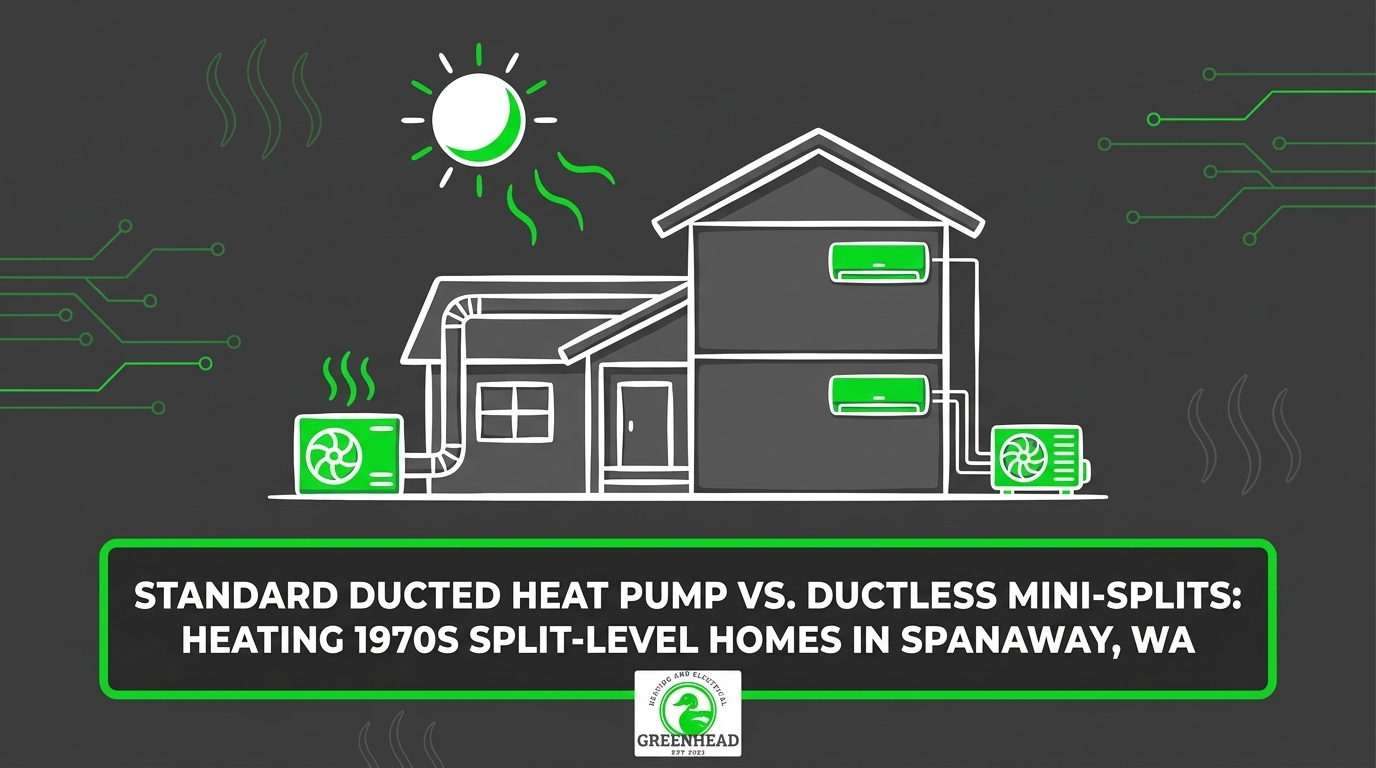
Standard Ducted Heat Pump vs Ductless Mini-Splits for 1970s Split-Level Homes in Spanaway
Why Your Split-Level Home Struggles with Uneven Heating Before Winter
Are you tired of sweltering upper floors while the lower levels remain freezing as fall temperatures drop, leaving you weighing a standard ducted heat pump vs ductless mini-splits for 1970s split-level homes in Spanaway? You are not alone in this frustration. At Greenhead Heating & Electrical, our team fields calls every fall from local homeowners dealing with this exact issue. The unique architectural layout of mid-century multi-level homes naturally creates distinct temperature zones that older, centralized heating systems simply cannot balance. As the cool, damp Pacific Northwest fall exacerbates the chill in those lower levels, targeted heating becomes highly valuable. The primary decision homeowners face right now is whether to utilize their existing infrastructure with ducted heat pump systems or bypass the aging ductwork entirely with a ductless mini-split installation.
Making this upgrade decision before freezing winter temperatures arrive is critical. The October pre-winter heating startup window is the ideal time to evaluate your home's thermal performance. Waiting until the deep freeze sets in often leads to rushed decisions and uncomfortable weeks spent relying on inefficient space heaters. By understanding the specific challenges of your home's layout, you can choose a modern heating solution that finally delivers consistent, whole-home comfort.
The Architectural Reality of Older Split-Level Layouts
To understand why your home feels so unbalanced, you have to look at the basic physics of heat distribution in this specific architectural style. Heat naturally rises. In a split-level home, the warm air produced by your furnace inevitably drifts up the open stairwells to the top floor, leaving the lower levels perpetually cold. Original heating systems installed five decades ago were rarely zoned to account for this thermal stratification, meaning the thermostat on the main floor shuts the system off long before the basement or lower living areas ever reach a comfortable temperature.
Furthermore, original 50-year-old ductwork was often poorly designed for modern airflow requirements. In the many Spanaway split-level developments built in the 1970s that our technicians inspect, we consistently find the duct systems were sized for high-heat gas or oil furnaces, not the steady, lower-temperature airflow of modern high-efficiency equipment. Any new system you install must overcome these inherent structural hurdles to achieve true whole-home comfort.
The Problem with 50-Year-Old Ductwork
When our experts evaluate a home's heating infrastructure, the condition of the hidden ductwork is often the biggest variable. Over decades of service in Pierce County, we typically see several critical degradation issues emerge:
• Deteriorating seals: The tape and mastic used in the 1970s dry out and crack over time, allowing conditioned air to escape into unconditioned crawlspaces or attics before it ever reaches your living room.
• Inadequate return air pathways: Mid-century construction often relied on a single, central return vent. This creates pressure imbalances in closed rooms, restricting airflow and making it incredibly difficult to heat isolated lower-level bedrooms.
• Significant energy loss: ENERGY STAR data indicates that older, leaky ductwork can lose 20 to 30 percent of the conditioned air moving through it. This massive duct leakage severely impacts overall system efficiency and drives up utility bills unnecessarily.
• Poor insulation: Ducts running through unheated spaces in older homes often lack modern insulation, meaning the air cools down significantly before it reaches the register.
Reusing Old Ductwork: Standard Ducted Heat Pumps
For many homeowners, the appeal of a centralized system lies in its invisibility. Utilizing hidden vents rather than wall-mounted units maintains the traditional aesthetic of the home. A standard ducted heat pump operates by pulling heat from the outside air and distributing it through your home's existing vent network. However, the success of this approach hinges entirely on the condition and capacity of that hidden infrastructure.
It is an absolute necessity to have your existing ductwork thoroughly inspected and sealed before installation. Forcing a high-efficiency, variable-speed heat pump to push air through leaky, undersized 1970s ducts will severely diminish its performance, leading to premature wear on the blower motor and disappointing comfort levels. If the ductwork is compromised, modifying your duct design to handle modern airflow becomes a mandatory part of the upgrade. There are also alternative ducted configurations to consider. During one complex custom installation our crew handled last fall, we navigated strict aesthetic constraints and noise review regulations by installing line sets inside walls and utilizing ceiling cassettes to avoid unsightly exterior conduits, proving that centralized comfort can be achieved without compromising the home's exterior look.
Pros of Centralized Ducted Systems
When the existing infrastructure is sound, centralized systems offer several distinct advantages:
• Aesthetic preservation: Maintains the traditional look of the home with out-of-sight equipment and flush floor or ceiling registers.
• Unified control: Provides complete temperature management from a single central thermostat, which many homeowners find intuitive and straightforward.
• Infrastructure leverage: Leverages existing infrastructure if the ducts are in excellent condition, potentially streamlining the installation process.
• Improved air filtration: Centralized systems allow for whole-home air purifiers and high-MERV media filters to be installed at a single point.
Cons and Limitations in Older Homes
Despite the aesthetic appeal, relying on old ducts presents significant challenges:
• Required modifications: Often requires extensive modifications to handle the specific static pressure and airflow requirements of modern variable-speed blowers.
• Persistent zoning issues: A single-zone ducted system does not inherently solve the hot-upstairs/cold-downstairs zoning issue that plagues split-level architecture.
• Hidden energy penalties: There is a potential for significant energy loss if hidden duct leaks in walls or ceilings are not fully addressed.
Bypassing the Ducts: Ductless Mini-Split Systems
When the existing ductwork is beyond repair or inherently incapable of balancing the home's temperatures, ductless mini-split systems offer a highly effective alternative. These multi-zone systems solve the specific zoning and duct-leakage issues in split-level architecture by delivering conditioned air directly to the rooms that need it most. By placing individual indoor air handlers in specific zones, homeowners can set different temperatures for the upper and lower levels, finally curing the chronic imbalance.
The efficiency gained by entirely eliminating ductwork is substantial. By bypassing the old infrastructure, you instantly eliminate the 20 to 30 percent air loss associated with aging, leaky ducts. This makes ductless technology exceptionally efficient, especially in the cool, damp climate of the Pacific Northwest. Furthermore, these systems offer incredible flexibility. During a recent fall project our installation team completed in an older house with a challenging layout and difficult attic access, our solution involved installing five mini-splits by routing the line sets creatively through the difficult attic space. The result was a quiet, highly efficient new heat pump system that preserved the home's exterior aesthetic while delivering targeted comfort to every level.
Pros of Ductless Zoning
Ductless systems are engineered to solve the exact problems found in Spanaway split-level developments:
• Targeted temperature control: Directly solves uneven heating by placing air handlers exactly where needed, allowing the cold lower floor to be heated independently of the warm upper floor.
• Zero duct loss: Eliminates the massive energy loss associated with aging, leaky ductwork, ensuring every ounce of heating power reaches your living space.
• Exceptional efficiency: Highly efficient inverter-driven operation is ideal for the Pacific Northwest climate, providing steady, continuous heat without the massive energy spikes of traditional systems.
• Rapid installation: Because there is no major ductwork to tear out or rebuild, installation is often less invasive to the home's interior structure.
Considerations for Ductless Installations
While highly effective, ductless systems do require specific accommodations:
• Visual footprint: Requires dedicated wall space, floor space, or ceiling space for the indoor air handler units.
• Creative routing: Complex multi-room layouts may require creative line set routing through attics or behind walls to maintain a clean exterior appearance.
• Routine maintenance: Routine filter cleaning is required at each individual indoor unit, rather than at a single central location.
The Hidden Hurdle: Electrical Panel Requirements
A critical, often-overlooked factor when modernizing the HVAC in a mid-century home is the electrical infrastructure. Many homes built in the 1970s were equipped with 100-amp electrical panels, which were perfectly adequate for an era of gas furnaces and minimal electronic devices. However, modern, whole-home heat pump systems typically require 200-amp service to operate safely and efficiently according to the National Electrical Code.
When upgrading from an old gas or oil furnace to a high-efficiency electric heat pump, the increased electrical load frequently necessitates a panel upgrade. For many homeowners, this introduces the logistical friction of hiring separate HVAC contractors and electricians for a single retrofit project, leading to scheduling delays, miscommunications, and extended periods without heat. Because our team at Greenhead provides both HVAC and electrical services in-house, our customers avoid the delays and headaches of coordinating multiple contractors for these necessary electrical panel upgrades. The entire project is managed under one roof, ensuring a seamless transition to modern heating.
It is also worth noting that general energy rebates or federal tax credits may apply to qualifying electrical and heat pump upgrades. Upgrading a dated panel alongside a high-efficiency heat pump often qualifies for various incentive programs designed to encourage home electrification. Homeowners should always verify current programs with their local utility providers or a tax professional to maximize their investment.
Side-by-Side: Which Heat Pump System Fits Your Home?
Choosing between a ducted or ductless system requires balancing your home's specific architectural constraints with your personal comfort goals. Ducted systems are best when your existing ducts are in pristine condition, properly sized, and capable of achieving even airflow across all levels. Conversely, ductless systems are vastly superior for curing isolated cold spots, bypassing deteriorating infrastructure, and providing customized climate control for the notoriously stubborn lower levels of split-level homes.
Before making a final choice, we highly recommend having our professionals assess your home's specific airflow and structural capabilities. Understanding the true condition of your infrastructure is the only way to ensure your new system performs as advertised. Evaluating existing ductwork before adding a heat pump is a crucial step that prevents premature system failures and guarantees that your investment actually resolves the uneven heating in your Spanaway split-level development.
• Zoning Capability — Standard Ducted Heat Pump: Typically single-zone; heats the whole house at once, which can leave lower levels cold. — Ductless Mini-Split System: Multi-zone; allows independent temperature control for upper and lower floors.
• Installation Invasiveness — Standard Ducted Heat Pump: Low impact if ducts are perfect; highly invasive if ductwork requires replacement or major sealing. — Ductless Mini-Split System: Requires small wall penetrations for line sets; no major ceiling or wall tear-downs needed.
• Aesthetic Impact — Standard Ducted Heat Pump: Hidden from view; utilizes traditional flush floor or ceiling registers. — Ductless Mini-Split System: Visible indoor air handlers mounted on walls, floors, or recessed into ceilings.
• Energy Efficiency — Standard Ducted Heat Pump: High equipment efficiency, but susceptible to 20-30% energy loss if older ducts leak. — Ductless Mini-Split System: Maximum efficiency; zero duct loss ensures all generated heat reaches the living space.
• Best Application — Standard Ducted Heat Pump: Homes with recently updated, perfectly sealed, and properly sized ductwork. — Ductless Mini-Split System: 1970s split-levels with failing ductwork, uneven temperatures, and isolated cold zones.

Frequently Asked Questions About Heating Older Homes
How do you fix uneven heating in a split-level house?
The most effective way to fix uneven heating is to implement multi-zone systems like ductless mini-splits to control temperatures independently on each floor. Because heat naturally rises to the upper levels, a single central thermostat struggles to balance the whole house. By installing separate air handlers in the lower and upper living areas, you can directly target cold spots and ensure every level remains perfectly comfortable regardless of the outside temperature.
Is a ductless mini-split better than ducted for a 1970s home?
It often is, as it bypasses aging, leaky ductwork and provides targeted relief for drafty lower levels. Ductwork installed in the 1970s was rarely designed for the airflow requirements of modern heat pumps and often suffers from significant air leakage due to deteriorating seals. A ductless system eliminates this energy loss entirely, delivering highly efficient, customized heating directly to the rooms that need it most.
Can you put a heat pump in a split level house?
Yes, both ducted and ductless heat pumps can be installed, provided the electrical panel can support the load. The split-level architecture itself is not a barrier to heat pump technology; the challenge lies in choosing the right distribution method. Whether you adapt your existing ductwork for a central system or opt for a multi-zone ductless setup, a heat pump is an excellent, energy-efficient choice for these homes.
Do I need to upgrade my electrical panel for a heat pump?
Frequently yes; older 100-amp panels usually require upgrading to 200-amp service to safely power modern systems. When transitioning from older gas or oil heating to a whole-home electric heat pump, the electrical demand increases significantly. An outdated panel poses safety risks and may not meet current National Electrical Code requirements, making an upgrade a standard part of the modernization process.
Will a heat pump work efficiently during Pacific Northwest winters?
Modern high-efficiency heat pumps are exceptionally well-suited for the cool, damp winters in the region. Unlike older models that struggled in freezing temperatures, today's inverter-driven heat pumps can extract heat from the outside air even when temperatures drop well below freezing. They provide steady, consistent warmth without the dry, harsh heat associated with traditional combustion furnaces.
Solve Your Home's Cold Spots Before Winter Arrives
Addressing uneven heating before the freezing weather sets in is the best way to ensure your family stays comfortable all season long. Whether you are leaning toward a standard ducted heat pump vs ductless mini-splits for 1970s split-level homes in Spanaway, a clear, architecture-specific assessment will help you make a confident, informed upgrade decision. Do not wait until the October pre-winter heating startup window closes and the deep chill takes over your lower floors. Reach out to our team at Greenhead Heating & Electrical—we understand both the mechanical and electrical requirements of retrofitting older properties, and we are ready to help you explore your options for professional HVAC services in Spanaway today.
.svg)