Navigating Kirkland's Setback Requirements When Siting Your New AC Unit
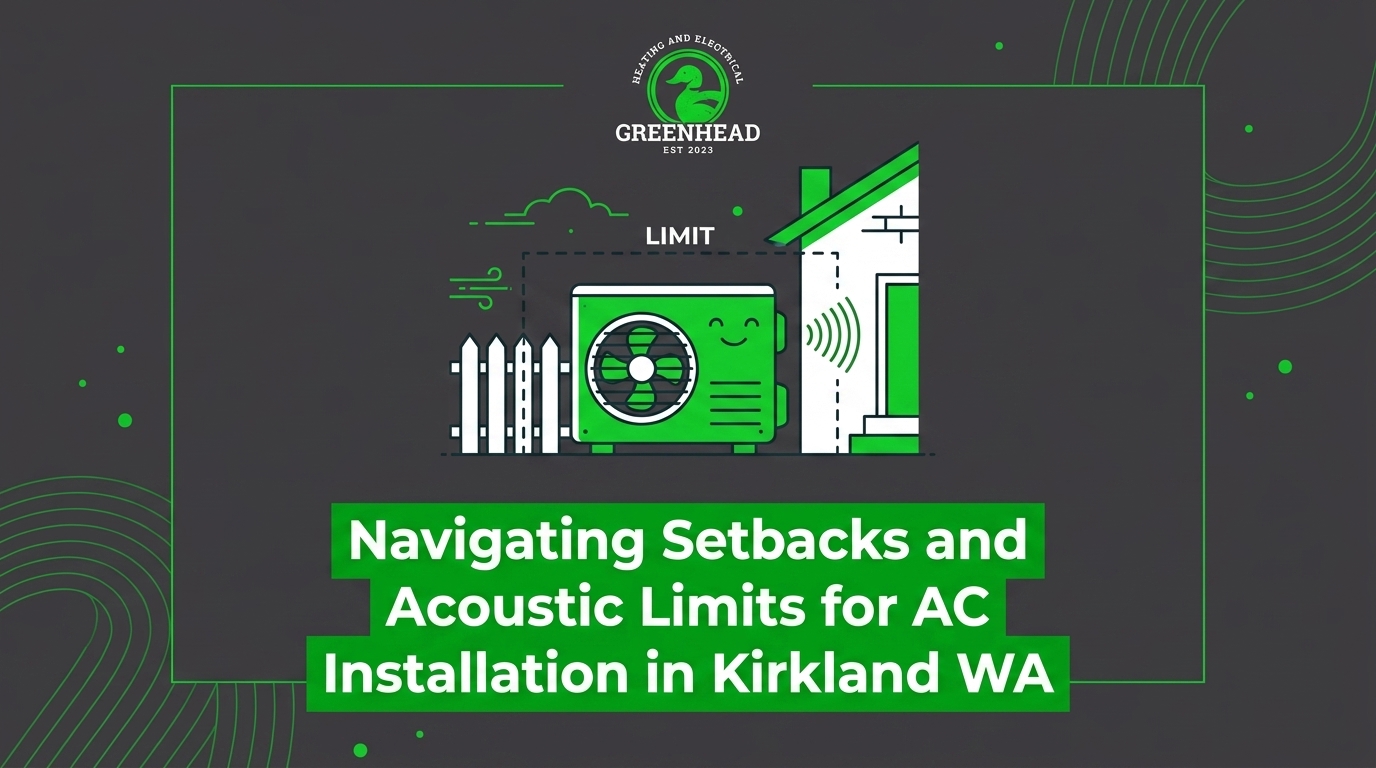
The Dual Challenge of Upgrading Your Cooling System in Dense Neighborhoods
Navigating Kirkland's setback requirements when siting your new AC unit is often the most unexpected hurdle homeowners face during a system upgrade. Our team at Greenhead Heating & Electrical LLC frequently meets homeowners who finally decide to replace their aging equipment or add cooling, only to discover that the most logical spot for the outdoor condenser is technically illegal under local zoning laws. In older, densely packed neighborhoods, property lines are tight, and outdoor space is at a premium. This creates a significant challenge for homeowners trying to modernize their comfort systems without violating municipal codes.
With the Pacific Northwest experiencing increasingly warm summers, we have seen a massive surge in cooling retrofits across the region. This demand is forcing modern, high-capacity HVAC equipment into older side yards that were never originally designed to house them. As a result, homeowners hit a frustrating bottleneck. Kirkland's strict property line setbacks and acoustic limits frequently force a complete redesign of standard side-yard condenser placements.
This leaves you facing a critical decision point. You must choose between relocating the condenser to a less convenient zone in your backyard—which often requires longer refrigerant lines—or investing in an ultra-quiet, low-decibel model that can legally operate within the tight confines of your existing side yard. What our technicians at Greenhead Heating & Electrical LLC have learned from years of navigating these municipal codes is that proactive planning prevents costly trial and error. If you are exploring your options, reviewing professional Air Conditioning solutions is the best way to understand what will legally fit on your lot.
Understanding Physical Setbacks Along Kirkland Residential Property Lines
Passing a municipal inspection starts with understanding the physical distance requirements mandated by the Kirkland Municipal Code (KMC). These zoning regulations dictate exactly where mechanical equipment can be placed in relation to your property boundaries. The primary goal of these codes is to maintain safe distances between structures, ensure emergency access, and prevent mechanical exhaust from venting directly into a neighbor's living space.
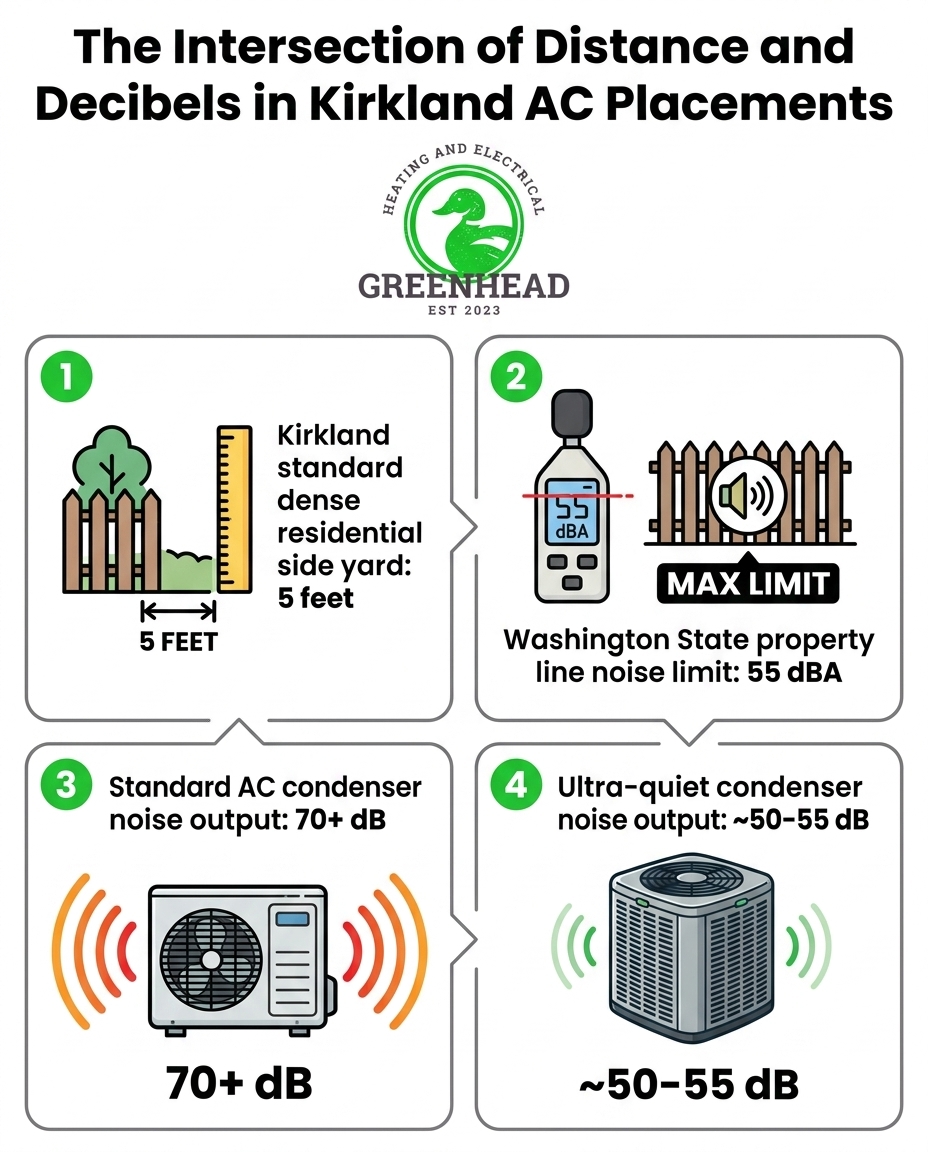
In our experience walking lots across the Puget Sound region, homes frequently feature narrow side yards that measure exactly five feet from the exterior wall to the property line. This makes standard condenser placement highly restrictive. A typical central air conditioner is roughly three feet wide. If you place a three-foot unit in a five-foot side yard, you are left with very little clearance on either side, which immediately triggers scrutiny from local code enforcement regarding Kirkland residential property lines.
The Conflict Between HVAC Clearances and Zoning Laws
Clearing the municipal lot line rules is only the first half of the equation. You must also satisfy the manufacturer's required HVAC clearances for proper airflow and maintenance access. If a unit is choked for air, it will overheat, consume excessive electricity, and fail prematurely. Balancing these two sets of rules requires precision.
• Manufacturer Wall Clearance — Typical Requirement: 12 to 24 inches — Why It Matters: Ensures the unit can pull in enough ambient air to cool the internal condenser coils efficiently.
• Service Access Clearance — Typical Requirement: 30 to 36 inches — Why It Matters: Provides enough physical space for a technician to safely open the service panel and test electrical components.
• Municipal Property Line Setback — Typical Requirement: Varies (often 3 to 5 feet) — Why It Matters: Keeps mechanical equipment away from neighboring structures to comply with local fire and zoning codes.
When you combine a 24-inch wall clearance with a 36-inch unit width, you have already consumed five feet of space before even accounting for the property line setback. This mathematical reality is why planning an AC installation in Kirkland requires specialized local knowledge rather than generic placement strategies.
The Invisible Boundary: Acoustic Ratings and Decibel Limits
Many homeowners are surprised to learn that a condenser can meet every physical distance requirement and still fail a local inspection. This happens because of the invisible boundary created by local noise ordinances. Washington State maximum environmental noise levels (specifically WAC 173-60) establish strict rules about how much sound your mechanical equipment is allowed to project into your neighbor's yard.
The standard residential noise limit is 55 dBA, and this measurement is taken at the receiving property line, not right next to the unit itself. This distinction is crucial. It means the acoustic rating / decibel (dB) limits of your chosen equipment must be low enough that the sound dissipates to 55 dBA or lower by the time it travels across your side yard and hits the invisible property line.
How Standard Equipment Fails the Noise Test
A standard, entry-level AC condenser typically operates at 70 decibels or higher. While 70 decibels is perfectly normal for outdoor mechanical equipment, it is far too loud for a narrow five-foot side yard. Sound degrades over distance, but five feet is not enough physical space for a 72-decibel unit to quiet down to the legal 55-decibel limit.
• The baseline volume: A standard unit running at full capacity generates a constant hum that easily penetrates nearby windows.
• The echo effect: Narrow side yards flanked by two tall exterior walls act like an echo chamber, amplifying the compressor noise and preventing it from dissipating naturally.
• The dual hurdle: Local code enforcement evaluates physical distance and noise levels together. You cannot pass inspection by satisfying only one requirement.
Because these codes are strictly enforced throughout the Kirkland HVAC service area, failing to account for the acoustic output before installation usually results in a rejected permit and a mandate to remove or relocate the brand-new equipment.
Real-World Solutions: Relocation vs. Low-Decibel Equipment
When faced with a side yard that is too narrow or an acoustic rating that is too high, you have two primary, actionable solutions. Our real-world local project experience at Greenhead Heating & Electrical LLC navigating Kirkland's specific municipal codes proves that having specialized regional expertise is far more valuable than generic HVAC knowledge. We approach these hurdles by engineering a solution that fits the specific geometry of your lot.
During a recent fall project where our crew was replacing an aging gas furnace, we encountered a very tight lot space for the new outdoor condenser. The homeowner wanted to upgrade to a highly efficient 4-zone mini-split system—which may also qualify for generic federal tax credits or utility energy rebates—but placing the unit in the traditional side yard immediately raised red flags regarding the noise review process. By carefully selecting ultra-quiet equipment and strategically running the refrigerant lines within the walls to reach an optimal outdoor location, we successfully managed the acoustic review. The system passed the city's noise inspection flawlessly, providing the home with superior comfort without violating the acoustic rating / decibel (dB) limits.
Option A: Strategic Condenser Relocation
The first option is to move the unit entirely. If the side yard is a no-go, our installers look to the backyard or a wider side alley. By placing the condenser further away from the property line, the distance naturally dissipates the noise before it reaches your neighbor. This often requires running longer electrical and refrigerant lines, but it allows you to utilize standard equipment without failing the noise review. Relocation is highly effective, provided your backyard has the square footage to accommodate the unit without disrupting your outdoor living space.
Option B: Investing in Low-Decibel Technology
If relocation is impossible—perhaps due to a patio, a retaining wall, or HOA rules—the second option is to upgrade the equipment itself. Ultra-quiet, low-decibel equipment, such as slim-line mini-split condensers or high-end variable-speed central units, are engineered specifically for dense urban environments. These units operate at a whisper-quiet 50 to 55 decibels directly at the source. Because they are already below the state limit before the sound even travels, they can legally operate within the tightest side-yard setbacks. If you are dealing with multi-family housing, reviewing Kirkland townhouse mini-split permitting strategies can reveal exactly how these low-decibel units solve compliance issues.
Why the September Pre-Heating Season System Transition is Ideal for Complex Upgrades
Tackling an HVAC upgrade that requires complex permitting, noise reviews, and potential system redesigns takes time. You cannot rush a municipal code review. This is why our team considers timing your installation strategically to make a massive difference in how smoothly the project unfolds. The September pre-heating season system transition is widely considered the optimal window to handle these complexities.
During the early fall, the frantic rush of emergency summer AC repairs has subsided, and the freezing winter weather has not yet arrived. This creates a perfect operational window for extensive outdoor work. Navigating mechanical permits and providing the necessary acoustic documentation to city inspectors is a process that requires patience. Initiating this process during the September pre-heating season system transition ensures your paperwork clears the city desk before the holiday season bottlenecks begin.
The Physical Advantages of Early Fall Installations
1. Favorable weather for concrete work: Pouring a new outdoor condenser pad requires dry, moderate temperatures. The heavy Pacific Northwest rains and freezing overnight temperatures of late fall and winter make leveling and curing concrete significantly more difficult.
2. Easier electrical routing: Running new dedicated electrical circuits often requires trenching or crawling under the home. Dry soil and moderate attic temperatures in September make this labor-intensive work much safer and faster for our electricians.
3. Proactive winter readiness: By upgrading your system in early fall, you ensure that your home is fully equipped with a reliable, legally permitted heating solution long before the first major freeze hits the region.
The Risks of Ignoring Local Siting Requirements
It can be tempting to hire a contractor who promises to skip the paperwork and just install the unit wherever it fits. However, we have been called in to fix enough botched jobs to know that the consequences of failing to account for Kirkland's dual requirements are severe and entirely fall on the homeowner. Code enforcement officers actively patrol neighborhoods, and neighbors are quick to report loud, nuisance equipment.
If your installation fails a municipal inspection, you will be forced to take corrective action. This usually means mandatory equipment relocation, which requires pumping down the refrigerant, cutting the lines, moving the heavy concrete pad, and extending the electrical circuits. Alternatively, the city might demand expensive acoustic baffling and sound walls, which are ugly, costly, and take up even more of your limited yard space. If you find yourself in a situation where an unpermitted unit is failing, you will likely need professional air conditioning repair in Kirkland to legally reroute the system.
The Hidden Cost of Poor Placement
Beyond the legal ramifications, improper placement severely impacts the lifespan of the equipment. Generic installations often try to hide the unit from the property line by shoving it deep into a corner, behind dense bushes, or under a low deck.
• Airflow suffocation: When a unit is boxed in to avoid a property line violation, it cannot breathe. The compressor works twice as hard to reject heat, driving up your monthly utility bills.
• Premature failure: Equipment that constantly overheats due to poor placement will suffer from premature compressor failure, turning a new investment into a recurring repair nightmare.
• Retroactive enforcement: Even if you manage to install the unit quietly, a future home appraisal or a complaint from a new neighbor can trigger a retroactive code enforcement action regarding Kirkland residential property lines.
Partnering with a team that is intimately familiar with these regulations prevents these costly, post-installation modifications.
Frequently Asked Questions About Kirkland AC Siting Rules
How close to the property line can an AC unit be in Kirkland?
In our experience, standard side yards in dense residential zones are often limited to just 5 feet of total width. When placing an AC unit, you must account for both the physical dimensions of the equipment and the manufacturer's required service clearances. Ultimately, the allowable distance is also dictated by the unit's decibel output to ensure it meets local noise codes at the boundary line.
Do I need a permit to install an AC in Kirkland?
Yes, a mechanical permit is strictly required for installing new air conditioning systems. During the permitting process, the city reviews the proposed placement and the manufacturer's acoustic specifications. This ensures the installation will comply with both the physical zoning laws and the local noise ordinances before any work begins.
What is the noise ordinance for AC units in Washington state?
Under WAC 173-60, Washington state restricts residential environmental noise to a maximum of 55 dBA measured at the receiving property line. Nighttime limits can be even stricter in certain jurisdictions, requiring careful equipment selection. Because standard units easily exceed this limit, acoustic ratings are a primary focus during local inspections.
Can I use acoustic blankets or fences to pass a noise inspection?
Sound blankets can reduce internal compressor noise slightly, but they generally do not solve the loud fan noise that pushes air out of the top of the unit. Solid barrier fences can help deflect sound, but they must be carefully designed so they do not restrict the critical airflow required for the unit to function efficiently. Relying on barriers is often riskier than simply choosing a quieter unit.
If my side yard is too narrow, what are my options?
Your primary options are relocating the unit to a more spacious backyard zone or installing ultra-quiet slim-line or mini-split condensers. Working with a local expert allows you to map out the exact decibel drop-off over distance. This ensures that whichever option you choose, the sound will dissipate legally before crossing your property line.
Partnering with Local Experts for Your Kirkland HVAC Upgrade
A successful cooling upgrade in a dense neighborhood requires much more than simply connecting wires and refrigerant lines. It requires a delicate balance between physical property setbacks and strict acoustic ratings. You need a team that understands how to engineer a solution that keeps your home comfortable without triggering a municipal code violation or a dispute with your neighbors.
At Greenhead Heating & Electrical LLC, we believe that you deserve clear guidance and viable equipment options to ensure your new system passes inspection seamlessly on the first try. By scheduling an evaluation during the September pre-heating season system transition, you give yourself the time needed to explore the best placement options for your specific lot. With the right planning, you can enjoy powerful, efficient cooling that respects both your property lines and your peace of mind.
.svg)